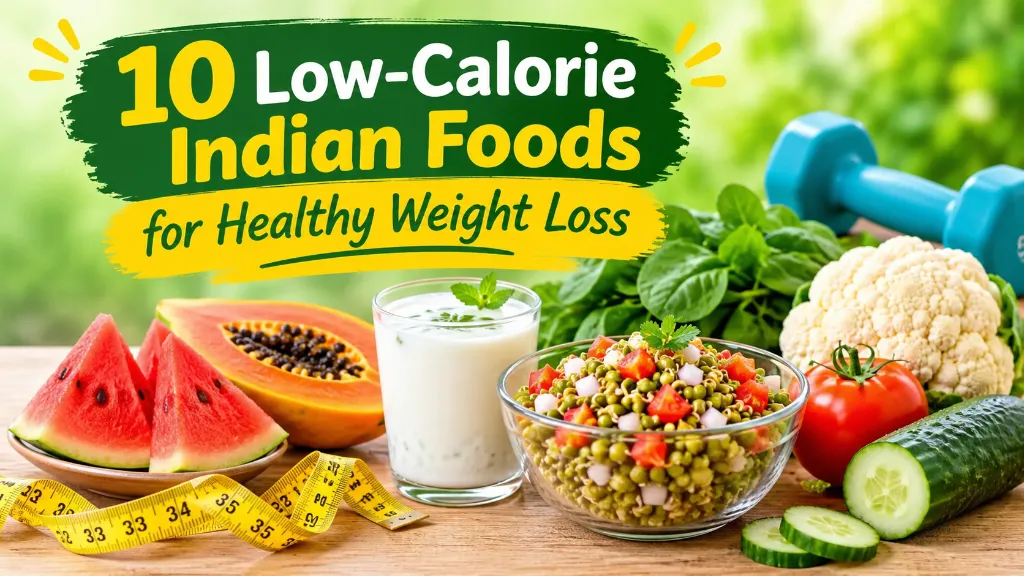
Some of the best low calorie Indian foods for healthy weight loss are everyday vegetables, fruits, sprouts, and light dairy staples with high water and fiber content: cucumber (~15 kcal/100 g), bottle gourd or lauki (~14 kcal/100 g), tomato (~18 kcal/100 g), spinach or palak (~23 kcal/100 g), cabbage (~25 kcal/100 g), cauliflower (~25 kcal/100 g), moong sprouts (~30 kcal/100 g), watermelon (~30 kcal/100 g), papaya (~43 kcal/100 g), and plain homemade buttermilk or chaas (~15–22 kcal/100 ml). Paired with adequate protein and moderate cooking oil, they help you feel full on fewer calories.
Many people trying to lose weight in India immediately assume they have to give up home-cooked roti, dal, sabzi, and curd in favor of expensive imported salads or strict meal replacements. That belief rarely lasts beyond a few weeks, because unfamiliar diets are hard to sustain with family meals and local ingredients.
In reality, healthy weight management comes down to overall energy balance and calorie density: how many calories a food provides relative to its weight and volume. Choosing the right low calorie Indian foods lets you fill your plate generously, enjoy familiar spices and textures, and still stay within your daily calorie budget without constant hunger.
In this guide, we examine 10 everyday Indian vegetables, fruits, sprouts, and dairy beverages, cucumber, bottle gourd (lauki), spinach (palak), cabbage, cauliflower, tomato, moong sprouts, watermelon, papaya, and plain buttermilk (chaas). You will find verified calorie counts per 100 grams and per realistic household serving, raw versus cooked differences, breakfast and dinner ideas, an illustrative meal plan, and practical cooking swaps.
Quick Answer – 10 Low-Calorie Indian Foods at a Glance
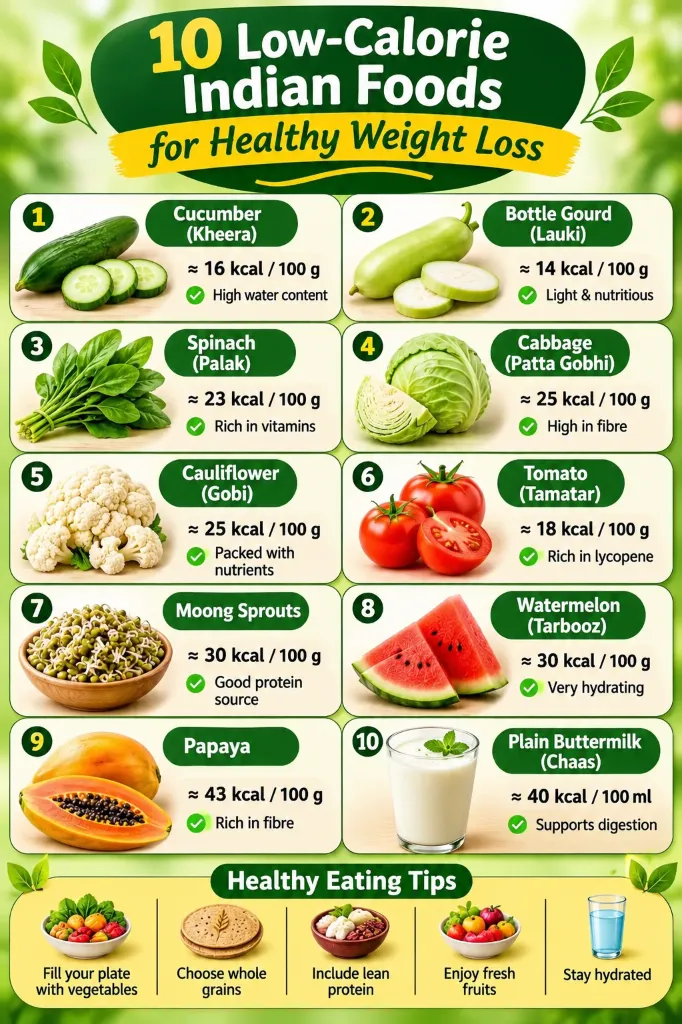
The table below summarizes verified calorie counts from USDA FoodData Central and the ICMR-NIN Indian Food Composition Tables. Notice that figures for vegetables, fruits, and sprouts refer to plain raw or steamed/boiled items before adding cooking oil, ghee, butter, or sugar.
| Food | Calories per 100 g / 100 ml | Typical Serving | Calories per Serving | Nutritional Highlight |
|---|---|---|---|---|
| 1. Cucumber (Kheera) (raw, unpeeled) | ~15 kcal | 1 medium cucumber (~150 g) | ~23 kcal | ~95% water; crisp meal volume |
| 2. Bottle Gourd (Lauki) (raw / boiled, plain) | ~14–15 kcal | 1 cup cooked cubes (~150 g, no oil) | ~22 kcal | ~95% water; gentle on digestion |
| 3. Spinach (Palak) (raw / boiled, drained) | ~23 kcal | 1 cup boiled (~180 g) / 2 cups raw (~60 g) | ~41 kcal (boiled) / ~14 kcal (raw) | Folate, vitamin K, vitamin A, iron |
| 4. Cabbage (Patta Gobhi) (raw / boiled) | ~23–25 kcal | 1 cup shredded raw (~75 g) | ~19 kcal | Dietary fibre & vitamin C |
| 5. Cauliflower (Gobi) (raw / boiled) | ~23–25 kcal | 1 cup florets (~110 g) | ~27 kcal | Vitamin C, fibre, low energy density |
| 6. Tomato (Tamatar) (raw) | ~18 kcal | 1 medium tomato (~123 g) | ~22 kcal | Lycopene, vitamin C, potassium |
| 7. Moong Sprouts (prepared, raw / steamed) | ~21–30 kcal | 1 cup prepared sprouts (~104 g) | ~25–31 kcal | ~3 g plant protein, folate, fibre |
| 8. Watermelon (Tarbooz) (raw) | ~30 kcal | 1 cup diced (~152 g) | ~46 kcal | ~91% water, lycopene, vitamin C |
| 9. Papaya (raw ripe fruit) | ~43 kcal | 1 cup cubed (~145 g) | ~62 kcal | Vitamin C, beta-carotene, ~2.5 g fibre |
| 10. Plain Buttermilk (Chaas) (homemade, diluted toned curd) | ~15–22 kcal per 100 ml | 1 tall glass (250 ml) | ~38–55 kcal | 2–3 g protein, calcium, hydrating |
These foods can help make meals more filling and nutrient-rich while keeping calorie intake manageable. However, overall weight management depends on total dietary intake, portion sizes, activity, and individual energy requirements.
1. Cucumber (Kheera) – A Refreshing, Low-Calorie Food
Cucumber is a staple salad vegetable across India, valued for its cool crunch during hot summers and its mild taste alongside spicy curries. Because it requires no cooking, it is one of the fastest ways to add volume to lunch or dinner.
- Calories per 100 g: Raw unpeeled cucumber provides about 15 kcal (peeled is closer to 12 kcal), ~0.7 g protein, ~3.6 g carbohydrate, and ~0.5 g fibre.
- Calories per serving: One medium cucumber (~150 g) contains roughly 22 to 23 kcal; one cup of slices (~104 g) supplies about 16 kcal.
- Nutritional profile: Roughly 95% water, cucumber also contributes small amounts of vitamin K, potassium, and magnesium, with extra fibre in the green peel.
Eating a generous serving of cucumber before or alongside a main meal takes up space in the stomach and adds chewing time without adding meaningful calories. That physical volume helps reduce the urge to reach for second helpings of denser rice or fried sides.
Three practical Indian meal ideas:
- Kachumber cucumber salad: Toss diced cucumber with tomato, onion, coriander, roasted cumin, and fresh lemon juice.
- Kheera raita: Fold grated cucumber into plain toned curd with black salt and mint leaves.
- Cucumber-sprout bowl: Mix chopped cucumber with steamed moong sprouts and chaat masala for an afternoon snack.
Calorie-conscious preparation tip: Wash well and leave the skin on when tender for extra fibre, and skip heavy mayonnaise or creamy dressings in favor of lemon juice and spices.
2. Bottle Gourd (Lauki) – A Light Vegetable for Everyday Meals
Bottle gourd, known as lauki, dudhi, or ghiya across Indian kitchens, is a pale-green gourd prized for mild flavor and easy digestibility. It absorbs aromatic tadkas smoothly while remaining one of the lightest cooked vegetables on any plate.
- Calories per 100 g: Raw bottle gourd supplies roughly 14 kcal per 100 g, and plain boiled bottle gourd contains ~15 kcal per 100 g (water content is ~95.5%).
- Calories per serving: A 1-cup cooked serving (~150 g) prepared without excess fat provides around 22 kcal (adding 1 teaspoon of cooking oil adds ~40 kcal to the dish).
- Nutritional profile: Provides modest vitamin C, potassium, B vitamins, and gentle soluble and insoluble fibre (~0.5 to 1.2 g per 100 g).
Because lauki is mild and watery, it blends seamlessly into dals, soups, and rotis to stretch meal volume while keeping total dish calories low. Just avoid bitter-tasting lauki, always taste a tiny raw piece first and discard any bottle gourd that tastes bitter, as bitterness indicates toxic cucurbitacins.
Three practical Indian meal ideas:
- Light lauki sabzi: Pressure-cook diced lauki with cumin, turmeric, ginger, tomato, and only 1 teaspoon of oil for a family pot.
- Lauki soup: Simmer lauki with onion, garlic, and black pepper, then blend smooth without cream or butter.
- Lauki chana dal: Cook bottle gourd cubes together with soaked chana dal to combine high-volume vegetables with plant protein.
Calorie-conscious preparation tip: Measure oil with a teaspoon instead of pouring directly from the bottle, and build flavor with roasted cumin, garlic, green chilies, and fresh coriander.
3. Spinach (Palak) – A Nutrient-Rich Leafy Vegetable
Spinach (palak) is one of the most nutrient-dense leafy greens in Indian cooking, appearing in everything from simple stir-fries to rich restaurant curries. While spinach is not a special "fat-burning" food, its high micronutrient density on very few calories makes it helpful when eating in a calorie deficit.
- Calories per 100 g: Both raw and plain boiled, drained spinach provide roughly 23 kcal per 100 g (~2.9 g protein, ~2.2 g fibre, ~91% water).
- Calories per serving: Two cups of raw spinach (~60 g) contain only ~14 kcal, whereas 1 cup of cooked, packed spinach (~180 g) delivers ~41 kcal, ~5.3 g protein, and ~4.3 g fibre.
- Nutritional profile: Rich in folate, vitamin K, vitamin A (beta-carotene), vitamin C, potassium, and non-heme iron (pair with lemon or tomatoes to improve iron absorption).
Notice the sharp contrast between home-style palak and restaurant palak paneer: the leafy vegetable itself has barely 40 calories per cooked cup, whereas heavy cream, butter, and fried paneer in restaurant gravies can push a single bowl past 350 to 450 calories.
Three practical Indian meal ideas:
- Lehsuni palak sabzi: Quickly sauté chopped spinach with crushed garlic, cumin, and a teaspoon of oil.
- Light palak dal: Stir finely chopped spinach leaves into cooked moong or masoor dal during the final 5 minutes of simmering.
- Clear palak tomato soup: Blend blanched spinach with roasted tomatoes, garlic, and pepper instead of heavy cream.
Calorie-conscious preparation tip: Skip cream and excess ghee in palak gravies; blending a small spoonful of curd or soaked cashews sparingly gives silkiness with far fewer calories.
4. Cabbage (Patta Gobhi) – A Fibre-Rich, Low-Calorie Vegetable
Cabbage (patta gobhi) is an affordable, year-round cruciferous vegetable that stays crisp in raw salads and turns tender when lightly sautéed with mustard seeds and curry leaves. Its sturdy leaves provide satisfying bulk for very little energy.
- Calories per 100 g: Raw green cabbage provides about 25 kcal per 100 g (~1.3 g protein, ~5.8 g carbohydrate, ~2.5 g fibre); boiled cabbage is ~23 kcal per 100 g.
- Calories per serving: One cup of shredded raw cabbage (~75 g) yields roughly 19 kcal; one cup of plain cooked cabbage (~150 g) has ~35 kcal.
- Nutritional profile: Supplies roughly 36 mg of vitamin C per 100 g raw, along with vitamin K, potassium, and protective glucosinolate plant compounds.
Adding shredded cabbage to sandwiches, wraps, poha, or stir-fries increases chewiness and fibre, helping slow down eating speed and supporting fullness after meals.
Three practical Indian meal ideas:
- Cabbage carrot koshimbir: Toss shredded cabbage and grated carrot with lemon juice, green chili, and a light mustard-seed tempering.
- Light patta gobhi matar sabzi: Sauté cabbage with green peas, turmeric, cumin, and minimal oil without overcooking.
- Vegetable stir-fry with tofu: Stir-fry sliced cabbage, bell peppers, and pressed firm tofu with ginger and soy sauce.
Calorie-conscious preparation tip: Avoid deep-fried cabbage snacks like crispy gobi/cabbage manchurian; steam or dry-sauté shredded cabbage first so it requires very little oil.
5. Cauliflower (Gobi) – A Versatile Vegetable for Calorie-Conscious Meals
Cauliflower (phool gobi) holds a beloved place in North Indian winters and everyday kitchens. While cauliflower is not nutritionally identical to rice or potatoes, it provides a much lower-calorie base when you want hearty textures without heavy starch loads.
- Calories per 100 g: Raw cauliflower contains 25 kcal per 100 g (~1.9 g protein, ~5.0 g carbohydrate, ~2.0 g fibre); plain boiled cauliflower provides ~23 kcal per 100 g.
- Calories per serving: One cup of chopped florets (~110 g) delivers about 27 kcal.
- Nutritional profile: An excellent source of vitamin C (~48 mg per 100 g raw), vitamin K, folate, and choline.
Compare plain cauliflower (~25 kcal/100 g) with boiled potatoes (~87 kcal/100 g) or traditional deep-fried aloo gobi: swapping part of the potato in mixed vegetable curries for extra cauliflower florets lowers calorie density while keeping the plate generous.
Three practical Indian meal ideas:
- Steamed spiced gobi florets: Steam florets until crisp-tender and toss with roasted cumin, turmeric, amchur, and coriander.
- Light gobi matar sabzi: Cook cauliflower with green peas, ginger, and tomato puree instead of deep-frying the florets first.
- Grated cauliflower paratha stuffing: Mix finely grated, squeezed cauliflower with ajwain and green chili inside a single measured whole-wheat roti.
Calorie-conscious preparation tip: Never deep-fry cauliflower florets before adding them to gravy; roasting in an air fryer or oven with a light oil brush keeps calories low.
6. Tomato (Tamatar) – A Low-Calorie Ingredient Packed with Nutrients
Tomatoes form the flavor base of countless Indian dals, rasams, and curries, yet they are equally useful eaten fresh in salads and light soups. Their natural acidity and umami taste brighten meals without needing butter or cream.
- Calories per 100 g: Raw red tomatoes contain only 18 kcal per 100 g (~94.5% water, ~0.9 g protein, ~3.9 g carbs, ~1.2 g fibre).
- Calories per serving: One medium whole tomato (~123 g) provides roughly 22 kcal; one cup of chopped tomatoes (~180 g) has ~32 kcal.
- Nutritional profile: Rich in vitamin C (~13.7 mg/100 g), potassium, folate, and lycopene, a carotenoid antioxidant whose absorption improves slightly when cooked with a small amount of healthy oil.
Using pureed fresh tomatoes to thicken curries gives rich body and tang for a fraction of the calories of cashew, cream, or makhani bases.
Three practical Indian meal ideas:
- Fresh tomato cucumber salad: Slice ripe tomatoes with cucumber, red onion, black pepper, and fresh basil or mint.
- Homestyle tomato soup (rasam-style): Simmer chopped tomatoes with garlic, cumin, pepper, and curry leaves, skipping cream, butter croutons, and added sugar.
- Tomato-onion curry base: Build sabzis on slow-simmered tomato-onion puree rather than heavy oil or cream sauces.
Calorie-conscious preparation tip: Beware of restaurant-style tomato soups and butter-masala gravies that hide tablespoons of sugar, butter, and heavy cream.
7. Moong Sprouts – A Light, Fibre-Rich Plant Protein Option
Sprouted green gram (moong sprouts) bridges the gap between low-calorie vegetables and higher-protein legumes. Sprouting softens the outer seed coat and turns dense dry beans into a crisp, hydrated, high-volume ingredient.
- Calories per 100 g: Prepared raw mung bean sprouts contain roughly 30 kcal per 100 g (~90.4% water, ~3.0 g protein, ~5.9 g carbs, ~1.8 g fibre). Lightly boiled/steamed drained sprouts provide ~21 to 28 kcal per 100 g depending on water retention. Do not confuse dry whole moong (~347 kcal/100 g) with hydrated sprouts.
- Calories per serving: One cup of prepared sprouts (~104 g) provides about 25 to 31 kcal and ~3 g of protein.
- Nutritional profile: Supplies folate (~61 µg/100 g), vitamin C, potassium, magnesium, and plant protein.
Important Food Safety Note: Warm, humid sprouting conditions allow bacteria such as Salmonella or E. coli to grow if seeds or water are contaminated. Always rinse sprouts thoroughly under clean running water and steam, boil, or lightly sauté them before eating, especially for young children, pregnant women, older adults, or anyone with a weakened immune system.
Three practical Indian meal ideas:
- Steamed moong sprout chaat: Steam sprouts for 4 to 5 minutes, then toss with diced tomato, cucumber, onion, coriander, roasted cumin, and lemon juice.
- Moong sprout vegetable bowl: Mix cooked sprouts with shredded cabbage, grated carrot, and a spoonful of hung curd.
- Light moong sprout stir-fry: Quick-toss steamed sprouts with mustard seeds, curry leaves, turmeric, and green peas for breakfast.
Calorie-conscious preparation tip: Skip deep-fried sev or sugary tamarind chutneys on chaat; use fresh lemon juice, mint chutney, and crunchy raw vegetables instead.
8. Watermelon (Tarbooz) – A Hydrating, Low-Calorie Fruit
Watermelon is a summer favorite that satisfies sweet cravings while delivering mostly water and electrolytes. Compared with packaged snacks or sweets, a bowl of chilled watermelon offers refreshing volume for very few calories.
- Calories per 100 g: Raw watermelon supplies about 30 kcal per 100 g (~91.5% water, ~7.6 g carbs, ~0.6 g protein, ~0.4 g fibre).
- Calories per serving: One generous cup of diced cubes (~152 g) provides roughly 46 kcal; a medium wedge (~286 g) contains ~86 kcal.
- Nutritional profile: Provides vitamin C, potassium, lycopene, and the amino acid L-citrulline.
Always choose whole sliced watermelon over strained watermelon juice. Chewing whole fruit slows intake and preserves natural texture, whereas straining fruit into juice makes it easy to drink two or three servings' worth of natural sugar in seconds without feeling full.
Three practical Indian meal ideas:
- Mid-morning chilled watermelon cubes: Eat 1 to 1.5 cups of fresh cubes seasoned with a pinch of chaat masala or black salt.
- Watermelon mint cucumber bowl: Combine diced watermelon, crisp cucumber, fresh mint leaves, and a squeeze of lime.
- Watermelon & paneer cube salad: Pair sweet watermelon cubes with 40 g of crumbled low-fat paneer and cracked black pepper for protein balance.
Calorie-conscious preparation tip: Enjoy watermelon plain as a whole-fruit snack and avoid blending it with added sugar, syrups, or ice cream.
9. Papaya – A Naturally Sweet, Fibre-Containing Fruit
Ripe papaya is widely available across India year-round and brings soft, tropical sweetness to breakfast plates without added sugar. Its vibrant orange flesh signals rich antioxidant pigments alongside gentle dietary fibre.
- Calories per 100 g: Raw ripe papaya provides roughly 43 kcal per 100 g (~88% water, ~10.8 g carbs, ~1.7 g fibre, ~0.5 g protein).
- Calories per serving: One cup of cubed papaya (~145 g) supplies about 62 kcal and ~2.5 g of dietary fibre.
- Nutritional profile: One of the richest everyday fruit sources of vitamin C (~60.9 mg per 100 g), along with beta-carotene (a vitamin A precursor), folate, and potassium.
Including a measured cup of papaya at breakfast or as an afternoon snack provides pleasant natural sweetness and fibre, helping displace calorie-dense biscuits or pastries. Keep expectations realistic: papaya supports everyday nutrition well, though it does not independently cure digestive disorders or cause fat loss on its own.
Three practical Indian meal ideas:
- Fresh papaya morning bowl: Serve 1 cup of ripe papaya cubes with a squeeze of lime juice and a pinch of roasted cumin or black pepper.
- Papaya with plain curd: Pair diced papaya with 100 g of plain curd or Greek yogurt and a teaspoon of pumpkin seeds for protein.
- Papaya mid-afternoon snack: Keep pre-cut chilled papaya cubes ready in the fridge for sweet cravings between lunch and dinner.
Calorie-conscious preparation tip: Stick to 1 to 1.5 cups per serving and avoid topping fruit bowls with honey, condensed milk, or sugar syrups.
10. Plain Buttermilk (Chaas) – A Light Indian Dairy Beverage
Traditional Indian chaas, made by whisking plain curd with plenty of water, roasted cumin, ginger, and mint, is one of the lightest, most refreshing dairy beverages available. It cools the palate after meals while adding hydration and a modest amount of protein and calcium.
- Calories per 100 ml: Traditional homemade chaas prepared from 50 to 60 g plain toned curd diluted in 200 ml water provides roughly 15 to 22 kcal per 100 ml (varies with curd fat and water ratio).
- Calories per serving: One tall 250 ml glass supplies about 38 to 55 kcal, roughly 2 to 3 g of protein, and ~60 to 80 mg of calcium.
- Nutritional profile: Contains live probiotic cultures (when made from fresh curd), bioavailable dairy protein, calcium, and vitamin B12.
Be careful not to confuse homemade plain chaas with packaged sweetened lassi, mango shakes, or thick salted dairy drinks, which can carry 120 to 220+ calories per bottle. If you watch blood pressure or sodium intake, go easy on table salt and black salt, letting roasted cumin, crushed coriander, and mint carry the flavor.
Three practical Indian meal ideas:
- Classic jeera-pudina chaas: Whisk 3 tablespoons (~50 g) of plain toned curd with 200 ml cold water, roasted cumin powder, chopped mint, and a pinch of salt.
- Post-lunch digestive cooler: Sip a glass of plain chaas alongside lunch instead of sweet sodas or packaged fruit juices.
- Evening snack pairing: Pair a glass of chaas with a 30 g handful of roasted chana for a balanced, under-165-calorie afternoon snack.
Calorie-conscious preparation tip: Use toned or low-fat curd without adding cream, sugar, or fried boondi on top.
How Do Low-Calorie Foods Help with Healthy Weight Loss?
A calorie is simply a unit of energy. Your body maintains weight when the calories you consume roughly match the energy you burn through resting metabolism, daily movement, and exercise (energy balance). Consistent, sustainable weight loss happens when total energy intake stays modestly below total energy expenditure over time.
Low-calorie, water-rich, and fibre-rich foods help through low calorie density, fewer calories packed into each gram of food. Because stomach stretch receptors signal fullness based partly on physical volume and fibre bulk, larger plates of vegetables and whole fruits help you feel satisfied on fewer total calories.
Consider a practical comparison: two full cups of mixed cucumber, tomato, cabbage, and steamed moong sprouts (~250 g) deliver roughly 55 to 65 calories along with fibre, vitamin C, and hydration. By contrast, just 30 grams (a small handful) of deep-fried potato chips or bhujia supplies roughly 155 to 170 calories in a few quick bites. That does not mean energy-dense foods like nuts, seeds, or occasional treats are unhealthy; it simply shows why filling half your plate with low-calorie vegetables gives you room to stay satisfied without overshooting your daily energy budget.
Keep in mind that eating fewer calories alone does not equal eating healthily. A diet built solely around low-calorie vegetables without adequate protein, healthy fats, or complex carbohydrates can leave you fatigued, hungry, and short on vital nutrients.
Best Low-Calorie Indian Breakfast Ideas
A smart breakfast balances modest calories with protein and fibre so mid-morning hunger stays manageable. Estimates below reflect standard home portions cooked with minimal oil, based on USDA and ICMR-NIN ingredient values:
| Breakfast Option | Typical Serving Size | Estimated Calories | Approx. Protein | Practical Preparation Tip |
|---|---|---|---|---|
| Vegetable Idli with Sambar | 3 medium idlis + 1 cup thin vegetable sambar | ~280 – 310 kcal | ~9 – 10 g | Add grated carrots or spinach to batter; keep coconut chutney to 1 tbsp. |
| Moong Dal Chilla | 2 medium chillas (1 tsp oil total) + mint chutney | ~230 – 260 kcal | ~12 – 14 g | Use a non-stick pan and fold in chopped onion, tomato, or 30 g grated paneer. |
| Vegetable Poha | 1 medium bowl (~180 g cooked, 1 tsp oil) | ~240 – 270 kcal | ~5 – 6 g | Load with green peas, onion, and capsicum; keep peanuts to 1 tbsp. |
| Vegetable Oats Upma | 1 medium bowl (~200 g cooked, 1 tsp oil) | ~210 – 240 kcal | ~6 – 7 g | Use rolled oats instead of instant flavored packets and add beans and peas. |
| Plain Curd with Fruit | 150 g toned curd + 1 cup papaya + 1 tsp seeds | ~180 – 200 kcal | ~6 – 7 g (higher with hung curd) | Skip sugar or honey; let ripe papaya provide natural sweetness. |
| Sprouted Moong Chaat | 1.5 cups steamed sprouts + chopped veggies + lemon | ~80 – 100 kcal | ~5 – 6 g | Pair with 1 glass of milk or a boiled egg/paneer slice for higher morning protein. |
Best Low-Calorie Indian Lunch and Dinner Ideas
Creating satisfying lower-calorie Indian lunches and dinners does not require starving on plain soup. Instead, use a simple balanced Indian plate layout: fill half your plate with non-starchy vegetables (lauki, palak, cabbage, cauliflower, salad), one-quarter with a solid protein source (thick dal, rajma, chana, low-fat paneer, tofu, soya chunks, or curd), and one-quarter with whole grains (measured roti, brown rice, or millets).
- Roti, thick dal, vegetable sabzi, and curd: Pair 2 medium whole-wheat rotis with 1 cup of dal, 1 cup of lightly sautéed cabbage or lauki sabzi, and 100 g plain curd.
- Lauki chana dal with cucumber salad: Simmer chana dal and bottle gourd together in one pressure-cooker pot and eat with 1 roti or small rice portion.
- Palak dal with steamed rice: Stir chopped spinach into masoor or moong dal to raise iron and fibre while keeping portions balanced.
- Vegetable moong dal khichdi: Cook moong dal and rice in a 1:1 ratio with cauliflower, peas, and carrots, served alongside crisp kachumber salad and chaas.
- Light vegetable soup with paneer or tofu: Pair a clear tomato or palak soup with 75 to 100 g of lightly grilled paneer or tofu so dinner feels complete.
- Moong sprouts salad + whole-grain roti: Combine steamed sprouts with tomato, cucumber, and chaas for an easy light dinner.
How to Reduce Calories in Everyday Indian Meals
Small kitchen habits often shape total daily calories far more than the raw vegetables you buy. Eight practical steps help keep home-cooked food light without losing flavor:
- Measure cooking oil instead of pouring freely: One tablespoon of oil or ghee carries ~120 calories. Using 1 to 2 teaspoons for an entire sabzi saves hundreds of calories per day.
- Prefer steaming, boiling, grilling, and light sautéing: Reserve deep-frying for occasional celebrations and use air-frying, tawa-roasting, or pressure cooking for daily dishes.
- Double the vegetable portion in mixed dishes: Add extra capsicum, cauliflower, peas, or spinach to poha, upma, pulao, and curries.
- Choose whole seasonal fruits over fruit juices: Eating whole papaya, watermelon, or guava preserves fibre and promotes better satiety.
- Trim added sugar in tea, coffee, and drinks: Reducing sugar from 2 teaspoons per cup to zero or half a teaspoon across multiple daily cups cuts empty calories quietly.
- Pick plain curd or chaas over sweetened beverages: Swap packaged lassi, cold coffee with ice cream, or soft drinks for homemade jeera chaas.
- Portion out fried snacks into a small bowl: Instead of eating namkeen, chips, or biscuits directly from the packet, serve a measured small portion or swap in roasted chana.
- Anchor every meal with adequate protein and fibre: Including protein from high-protein vegetarian foods alongside vegetables helps control hunger at subsequent meals.
| Instead of (Higher-Calorie Habit) | Try (Calorie-Conscious Swap) |
|---|---|
| Deep-fried pakora or samosa | Steamed moong dal chilla, idli, or lightly roasted snacks |
| Sugary soft drinks or packaged iced tea | Plain water, lemon water, or unsweetened chaas |
| Strained fruit juice with added sugar | Whole seasonal fruit (papaya, watermelon, guava, apple) |
| Cream-heavy restaurant soups | Homestyle tomato, palak, or lauki vegetable soup without cream |
| Excess-oil sabzi floating in tadka | Lightly sautéed sabzi cooked with 1 tsp measured oil |
| Frequent fried namkeen and biscuits | Roasted chana, cucumber chaat, or fresh fruit |
Note: None of the foods on the left must be banned forever; reserving richer items for occasional enjoyment while making lighter swaps your daily default supports steady progress.
How Many Calories Should You Eat to Lose Weight?
No single daily calorie target works for everyone. Your individual energy need depends on your age, biological sex, height, current body weight, muscle mass, and daily physical activity.
Nutritionists commonly estimate baseline energy needs in two steps using the Mifflin-St Jeor equation:
- BMR (Basal Metabolic Rate): Estimates the calories your body burns at complete rest just to support breathing, circulation, and organ function.
- TDEE (Total Daily Energy Expenditure): Multiplies your BMR by an activity factor (from sedentary desk work to vigorous training) to estimate your total maintenance calories per day.
A calorie deficit simply means consuming slightly fewer calories than your TDEE over time, typically a moderate reduction of 300 to 500 kcal per day below maintenance. Very-low-calorie crash diets are rarely sustainable and increase the risk of muscle loss, fatigue, micronutrient deficiencies, and rebound weight gain.
You can also read our Daily Calorie Intake Guide or check your body mass index using the BMI Calculator, keeping in mind that BMI is only a general screening measure and does not directly assess body fat, muscle mass, or overall health. Learning how to read nutrition labels also helps you track packaged foods accurately.
Sample Indian Meal Plan Using Low-Calorie Foods
The illustrative one-day menu below demonstrates how the 10 low-calorie foods fit naturally into familiar Indian meals alongside adequate protein and whole grains. This ~1,610 kcal menu is strictly an educational example, not a personalised diet prescription, your own ideal calorie and protein needs may be higher or lower depending on your size, sex, and activity level.
| Meal | Suggested Food & Illustrative Serving Size | Est. Calories | Est. Protein |
|---|---|---|---|
| Early Morning | Warm water or unsweetened green tea / black coffee (250 ml) | ~5 kcal | 0 g |
| Breakfast | 3 medium vegetable idlis + 1 cup thin vegetable sambar + 1 glass toned milk (250 ml) | ~400 kcal | ~17.5 g |
| Mid-Morning | 1.5 cups cubed papaya (~215 g) + 10 soaked almonds (~12 g) | ~162 kcal | ~3.5 g |
| Lunch | 2 medium whole-wheat rotis + 1 cup thick moong-toor dal + 1 cup light lauki sabzi + 100 g toned curd + 1 cup cucumber-tomato salad | ~520 kcal | ~21 g |
| Evening Snack | 1 cup steamed moong sprouts chaat (104 g sprouts + tomato, onion, lemon) + 1 tall glass plain homemade chaas (250 ml) + 20 g roasted chana | ~165 kcal | ~9.5 g |
| Dinner | 1.5 cups vegetable moong khichdi (with cauliflower & green peas) + 75 g lightly grilled tofu or low-fat paneer + 1 cup cabbage-cucumber salad | ~360 kcal | ~21 g |
| Illustrative Daily Total | Balanced vegetarian day with vegetables, fruit, sprouts, dairy, dal & grains | ~1,612 kcal | ~72.5 g |
Common Mistakes to Avoid When Eating Low-Calorie Foods
Even when choosing healthy, low-calorie ingredients, a few everyday habits can quietly stall progress or leave you undernourished:
- Eating too little and skipping balanced meals: Slashing calories too aggressively triggers fatigue, cravings, and muscle loss, making long-term consistency nearly impossible.
- Ignoring protein intake: Filling up purely on vegetable soups and fruits without dal, curd, paneer, tofu, or sprouts leaves meals short on protein and reduces satiety.
- Adding excessive oil to low-calorie vegetables: Two or three extra tablespoons of oil or ghee can turn a 30-calorie lauki or palak dish into a 350-calorie sabzi.
- Drinking fruit juice instead of eating whole fruits: Juicing removes fibre and packs multiple pieces of fruit into a quick liquid drink.
- Depending only on raw salads: Relying solely on salads can cause bloating in some people and lacks sufficient protein, iron, and energy for busy days.
- Ignoring serving sizes of calorie-dense add-ons: Nuts, seeds, peanut butter, and cheese are nutritious, yet generous handfuls add calories fast.
- Following extreme restrictive diets: Eliminating entire food groups like grains or dairy unnecessarily makes social and family eating stressful.
- Assuming "low-fat" or "fat-free" always means low-calorie: Many packaged low-fat yogurts, snacks, and biscuits compensate with extra added sugar and refined starch.
- Ignoring nutritional variety: Eating the same two vegetables every day limits your spectrum of vitamins, minerals, and gut-supporting fibres.
- Expecting rapid weight loss from individual foods: No single vegetable, fruit, or drink melts fat on its own; consistent habits over weeks and months drive lasting results.
Frequently Asked Questions About Low-Calorie Indian Foods
1. What are the 10 best low-calorie Indian foods for weight loss?
The 10 best low-calorie Indian foods include cucumber (~15 kcal/100 g), bottle gourd or lauki (~14 kcal/100 g), spinach (~23 kcal/100 g), cabbage (~25 kcal/100 g), cauliflower (~25 kcal/100 g), tomato (~18 kcal/100 g), prepared moong sprouts (~30 kcal/100 g), watermelon (~30 kcal/100 g), papaya (~43 kcal/100 g), and plain homemade chaas (~15–22 kcal/100 ml).
2. Which Indian vegetables are lowest in calories?
Water-rich gourds and salad vegetables are lowest in calories, led by bottle gourd (lauki at ~14 kcal/100 g), cucumber (~15 kcal/100 g), ridge gourd (turai), ash gourd, and tomato (~18 kcal/100 g). Leafy greens like spinach (~23 kcal/100 g) and cruciferous vegetables like cabbage and cauliflower (~25 kcal/100 g) also stay very light when cooked with minimal oil.
3. What can I eat for breakfast while trying to lose weight?
Light, filling Indian breakfasts include 2 to 3 vegetable idlis with sambar, moong dal chilla cooked with minimal oil, vegetable oats upma, vegetable poha with green peas, or plain curd topped with papaya. Pairing moderate carbohydrates with protein and vegetables keeps morning hunger steady until lunch.
4. Which Indian foods can I eat for dinner during weight loss?
Balanced, light Indian dinners include vegetable moong dal khichdi with salad, lauki chana dal with one or two rotis, palak dal with a measured portion of rice, or clear vegetable soup paired with grilled paneer or tofu. Keeping dinner oil light and portions measured supports comfortable digestion and overnight energy balance.
5. Is rice suitable for a weight-loss diet?
Yes, rice can fit into a weight-loss diet as long as your total portion size and daily calorie intake remain within your target range. Cooked white or brown rice provides about 120 to 130 kcal per 100 grams; pairing a measured cup of rice with thick dal, sabzi, and salad balances the meal well.
6. Is roti better than rice for weight loss?
Whole-wheat roti offers slightly more dietary fibre and protein than polished white rice, which can help some people feel full longer, though both provide similar calories per realistic meal portion. Choosing whichever grain helps you control total portions comfortably, and pairing it with vegetables and dal, matters more than avoiding rice.
7. Can I eat fruits every day while losing weight?
Yes, eating whole seasonal fruits like papaya, watermelon, guava, or apples every day supports weight management by supplying vitamins, hydration, and natural fibre on modest calories. Aim for 1 to 2 measured whole-fruit servings daily rather than drinking strained fruit juices, and account for them within your overall daily calories.
8. Does eating low-calorie food automatically cause weight loss?
No, no individual low-calorie food automatically causes weight loss on its own. Weight reduction occurs only when your total calorie intake across all meals, snacks, oils, and beverages stays consistently below your total daily energy expenditure, supported by balanced nutrition and regular physical activity.
9. How can I reduce calories in Indian cooking?
Measuring cooking oil and ghee with teaspoons instead of pouring freely is the fastest way to cut hidden calories in Indian meals. You can also favour steaming, boiling, and light sautéing over deep-frying, bulk up curries with extra lauki or tomato puree, and choose plain curd or chaas over creamy gravies.
10. How many calories should I eat daily to lose weight?
Daily weight-loss calories vary widely depending on age, sex, height, weight, and activity level, so there is no single number for everyone. Most healthy adults aim for a moderate 300 to 500 kcal daily deficit below their maintenance TDEE, which you can estimate using our free Calorie and TDEE Calculator.
Conclusion – Make Healthy Indian Eating Part of Your Lifestyle
Healthy weight management never requires abandoning traditional Indian kitchens or forcing yourself onto bland, unfamiliar menus. Everyday staples like cucumber, bottle gourd, spinach, cabbage, cauliflower, tomatoes, steamed moong sprouts, watermelon, papaya, and plain homemade chaas let you build colorful, satisfying plates that naturally keep calorie density low.
True progress comes from putting these low calorie Indian foods together with sensible portions of whole grains, reliable protein, measured cooking oils, regular physical activity, and patient consistency. If you want a practical starting point for your own daily targets, estimate your maintenance energy needs with our Calorie & TDEE Calculator and gradually build lighter, balanced habits you can enjoy for years.
References and Scientific Sources
- Indian Council of Medical Research – National Institute of Nutrition (ICMR-NIN). Dietary Guidelines for Indians (2024). Hyderabad: ICMR-NIN. Available from: ICMR-NIN Dietary Guidelines PDF
- Indian Council of Medical Research – National Institute of Nutrition (ICMR-NIN). Indian Food Composition Tables. Hyderabad: ICMR-NIN. Available from: https://www.nin.res.in/
- U.S. Department of Agriculture (USDA), Agricultural Research Service. FoodData Central: Nutrient profiles for Cucumber, Calabash/Bottle Gourd, Spinach, Cabbage, Cauliflower, Tomatoes, Mung Bean Sprouts, Watermelon, Papaya, and Buttermilk. Available from: https://fdc.nal.usda.gov/
- Rolls BJ. Dietary energy density: Applying behavioural science to weight management. Nutrition Bulletin. 2017;42(3):246-253. Available from: PubMed PMID 29151813.
- U.S. Food and Drug Administration (FDA) / FoodSafety.gov. Sprouts: What You Should Know (Food Safety Guidance). Available from: https://www.foodsafety.gov/keep-food-safe/food-poisoning/sprouts
SmartCalc Health & Nutrition Team
Our nutrition researchers synthesize ICMR-NIN Indian dietary guidance, USDA FoodData Central values, and peer-reviewed energy-balance studies into clear, practical guides for everyday health.