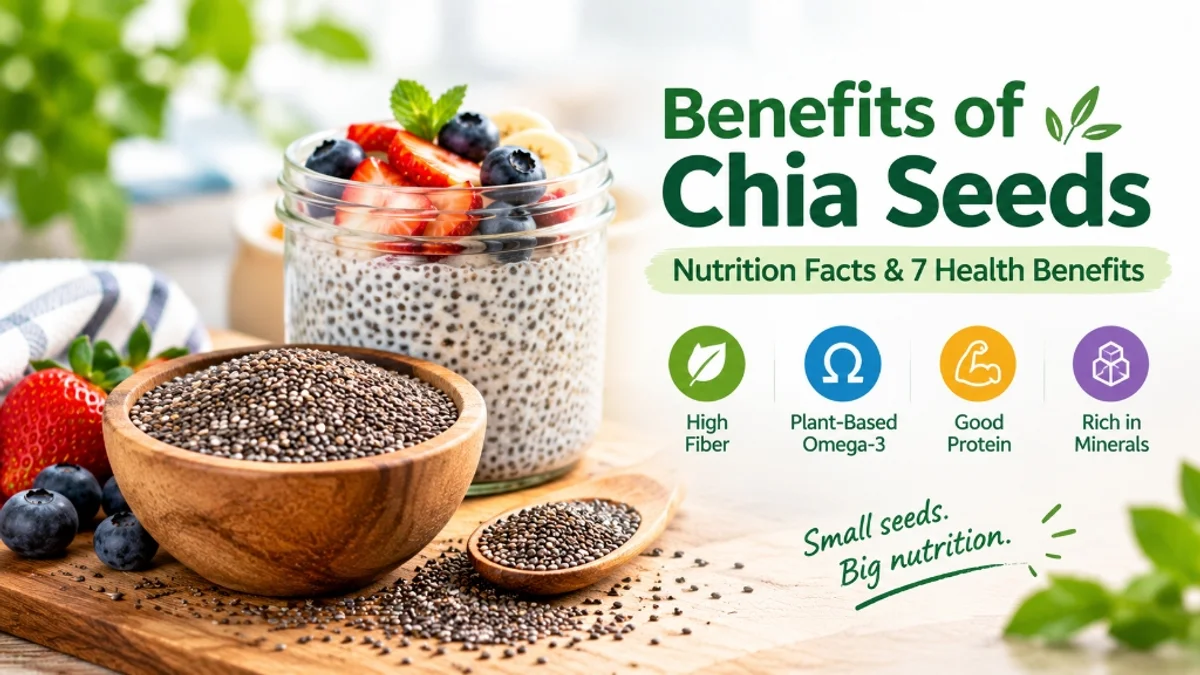
Chia seeds provide concentrated dietary fiber, plant-based alpha-linolenic acid (ALA) omega-3 fatty acids, modest protein, and bone minerals like calcium and magnesium. A single tablespoon (12 grams) supplies 58 calories and 4.1 grams of fiber while carrying almost no sugar. Their primary proven strength lies in improving meal satiety, slowing carbohydrate absorption, and supporting digestive regularity. They work best as an ingredient in a varied diet rather than an isolated cure for chronic conditions.
Tiny black and white chia seeds sit on kitchen shelves worldwide, stirred into breakfast bowls, blended into drinks, and baked into breads. People value these tiny seeds because a single spoonful adds noticeable bulk and nutrients without altering the flavor of a dish.
The practical benefits of chia seeds come down to density. Unlike many grain products stripped of their outer bran during processing, chia seeds remain whole foods. Each tiny seed holds a gel-forming outer coat rich in soluble mucilage, wrapped around a core packed with heart-healthy polyunsaturated fats and vital minerals. Understanding what the laboratory data confirms—and what popular marketing claims exaggerate—helps you use them safely and effectively in everyday cooking.
What Are Chia Seeds?
Chia seeds are the edible seeds of Salvia hispanica, an annual herbaceous flowering plant in the mint family (Lamiaceae). The plant is native to central and southern Mexico and Guatemala, where it served as a staple crop for Aztec and Mayan societies alongside corn and beans. In the Mayan language, the word "chia" translates roughly to "strength," reflecting its traditional role as a sustaining food for long journeys and physical labor.
The seeds are oval and flat, measuring roughly 1 to 2 millimeters across with a smooth, mottled coat in shades of black, gray, brown, and white. Their most distinctive physical trait is their hydrophilic exterior: when chia seeds come into contact with water or milk, the soluble polysaccharides in their outer wall swell. Within 15 minutes, they form a clear, viscous hydrogel that holds 10 to 12 times the seed's weight in liquid.
Today, home cooks use chia seeds to thicken fruit preserves, prepare overnight chia pudding, replace whole eggs in vegan baking, and boost the fiber count of homemade smoothies. While they offer high nutrient density per gram, keep in mind that chia seeds complement a nutritious diet rather than replacing other healthy whole foods.
Chia Seeds Nutrition Facts at a Glance
To evaluate what chia seeds contribute to your daily targets, examine verified laboratory figures from USDA FoodData Central (FDC ID: 170554, Seeds, chia seed, dried). The table below details the nutritional composition for 100 grams of whole dried chia seeds alongside a standard culinary serving of 1 level tablespoon (12 grams):

| Nutrient | Per 100 g Dried Seeds | Per 1 Tablespoon (12 g) | % Daily Value (per 100 g)* |
|---|---|---|---|
| Energy (Calories) | 486 kcal | 58 kcal | 24% |
| Protein | 16.54 g | 1.98 g | 33% |
| Total Fat | 30.74 g | 3.69 g | 39% |
| Saturated Fatty Acids | 3.33 g | 0.40 g | 17% |
| Monounsaturated Fat | 2.31 g | 0.28 g | — |
| Polyunsaturated Fat | 23.67 g | 2.84 g | — |
| Alpha-Linolenic Acid (ALA Omega-3) | ~17.8 g | ~2.14 g | 1,330% (vs 1.6 g AI) |
| Total Carbohydrates | 42.12 g | 5.05 g | 15% |
| Dietary Fiber | 34.40 g | 4.13 g | 123% |
| Total Sugars | 0.00 g | 0.00 g | 0% |
| Net Digestible Carbohydrates | 7.72 g | 0.92 g | — |
| Calcium | 631 mg | 75.7 mg | 49% |
| Iron | 7.72 mg | 0.93 mg | 43% |
| Magnesium | 335 mg | 40.2 mg | 80% |
| Phosphorus | 860 mg | 103.2 mg | 69% |
| Potassium | 407 mg | 48.8 mg | 9% |
| Zinc | 4.58 mg | 0.55 mg | 42% |
| Sodium | 16 mg | 1.9 mg | <1% |
*Percent Daily Values (% DV) are based on a 2,000-calorie reference diet established by the U.S. FDA. Values for tablespoon servings are calculated directly from dried seed weight (1 tbsp = 12 g). Rounded to one decimal place.
Looking closely at these numbers reveals why nutritionists pay attention to chia seeds. Over 80% of their total carbohydrate content consists of dietary fiber rather than simple sugars or digestible starches. When learning how to read nutrition labels, subtracting fiber from total carbohydrates gives you net carbs—leaving less than 1 gram of net carbohydrates per tablespoon. Also, roughly 58% of the total fat consists of plant-based alpha-linolenic acid, making chia one of the richest botanical omega-3 sources in the human diet.
7 Potential Health Benefits of Chia Seeds
Scientific interest in chia seeds has expanded over the past twenty years. While early rodent experiments sparked bold headlines, human clinical trials provide a more balanced picture. Below are 7 distinct health advantages associated with chia seeds, along with the physiological mechanisms and realistic research boundaries for each.
1. Supports Normal Bowel Regularity and Gut Health
A single tablespoon of chia seeds delivers over 4 grams of dietary fiber. Roughly 85% to 90% is insoluble fiber, while the remaining 10% to 15% is soluble fiber in the form of mucilage. This combination exerts two distinct actions in the human gastrointestinal tract:
- Insoluble fiber adds physical volume to the stool, promoting gentle peristaltic movement through the colon and preventing sluggish transit times.
- Soluble mucilage absorbs water within the bowel lumen, creating a slippery gel that lubricates the passage of stool and softens hard matter.
In addition, beneficial microbes in the large intestine ferment a portion of these soluble fibers, generating short-chain fatty acids (SCFAs) like acetate, propionate, and butyrate. Butyrate feeds colonocyte cells and helps sustain a healthy intestinal barrier.
2. Supplies Plant-Based ALA Omega-3 Fatty Acids
Fatty acids are structural components of cell membranes and precursors to signaling molecules. Chia seeds rank among the most concentrated terrestrial sources of alpha-linolenic acid (ALA), an omega-3 fat that your body cannot synthesize on its own. A 12-gram tablespoon yields more than 2.1 grams of ALA, comfortably meeting the daily adequate intake (AI) set by the National Academy of Medicine (1.1 grams for adult women and 1.6 grams for adult men).
ALA exhibits its own independent anti-inflammatory actions by downregulating inflammatory cytokines such as tumor necrosis factor-alpha (TNF-α) and interleukin-6 (IL-6). Plant polyphenols and antioxidant botanicals are frequently studied for cellular and vascular protection, as examined in our review of Neuro Serge.
3. Adds Plant-Based Protein to Everyday Meals
Protein supports muscle repair, enzyme production, and immune tissue synthesis. Whole chia seeds contain approximately 16.5 grams of protein per 100 grams, which is higher than most traditional cereal grains such as rice (2.7 g/100 g cooked), oats (13.2 g/100 g raw), or wheat. They contain all 9 diet-required amino acids—histidine, isoleucine, leucine, lysine, methionine, phenylalanine, threonine, tryptophan, and valine—making them an unusually well-balanced plant protein source.
4. Delivers Bioavailable Bone and Muscle Minerals
Many adults struggle to meet daily targets for bone-forming and neuromuscular minerals. Chia seeds deliver a concentrated package of micronutrients in small servings:
- Calcium (76 mg per tablespoon): Gram for gram, dried chia seeds contain more calcium than whole cow's milk (~631 mg vs ~120 mg per 100 g), supporting skeletal bone matrix maintenance.
- Magnesium (40 mg per tablespoon): Supplies roughly 10% of your daily magnesium requirement in a single spoon, assisting over 300 enzymatic reactions, muscle contraction, and cellular ATP synthesis.
- Phosphorus (103 mg per tablespoon): Works directly alongside calcium in hydroxyapatite crystals to maintain bone density and dental enamel.
- Non-heme Iron (0.9 mg per tablespoon): Supports hemoglobin synthesis and oxygen transport throughout circulating red blood cells.
5. Helps Regulate Satiety and Post-Meal Fullness
Managing appetite between meals is a frequent obstacle in healthy eating. Chia seeds influence hunger through physical and hormonal mechanisms. The high proportion of soluble fiber forms a dense, gelatinous matrix when mixed with gastric juices. This gel expands inside the stomach, exerting mechanical pressure on stomach stretch receptors that send fullness signals to the brain via the vagus nerve.
At the same time, this gel delays gastric emptying—the rate at which food leaves the stomach and enters the small intestine. By slowing the breakdown of co-ingested carbohydrates, chia blunts rapid blood glucose spikes and insulin surges, helping avoid the sharp energy drops that trigger between-meal cravings.
6. Contributes to a Heart-Healthy Dietary Pattern
Cardiovascular wellness relies on healthy blood vessel function, balanced blood lipids, and controlled systemic inflammation. Chia seeds bring together three components that support vascular health: viscous soluble fiber, plant sterols, and polyunsaturated ALA fats.
Soluble fiber binds bile acids in the small intestine, promoting their excretion in stool. Because bile acids are synthesized from circulating cholesterol, the liver extracts more LDL cholesterol from the bloodstream to replenish bile pools, gradually lowering serum LDL levels over time.
7. Offers Practical Culinary Flexibility and Food Chemistry Utility
A major obstacle to eating well is meal preparation difficulty. Many nutrient-dense foods require thorough cleaning, peeling, chopping, or lengthy boiling. Chia seeds require zero cooking and have virtually no flavor, meaning they can blend into savory or sweet recipes without clashing with spices or herbs.
Their soluble mucilage acts as a natural emulsifier, stabilizer, and binder. In baking, a "chia egg" (1 tablespoon whole or ground chia seeds mixed with 2.5 tablespoons warm water, rested for 5 minutes) creates a binding structure that mimics the moisture retention and leavening support of an egg in muffins, pancakes, and cookies. This provides a natural, whole-food alternative to commercial gums and additives.
Chia Seeds and Weight Management: What Does the Science Say?
Online wellness articles often describe chia seeds as a fat-burning superfood that melts away abdominal weight. It is helpful to address this question directly: chia seeds do not burn body fat or produce automated weight loss.
Human clinical trials evaluating this specific claim have produced clear findings. In a rigorous 12-week randomized trial conducted by Dr. David Nieman and colleagues at Appalachian State University (published in Nutrition Research), 90 overweight and obese men and women consumed either 50 grams of chia seeds daily or a calorie-matched placebo while maintaining their normal habits. At the end of 12 weeks, the researchers found no measurable differences between groups in body mass index (BMI), body composition, fat mass, or blood pressure.
Why, then, do so many registered dietitians recommend chia seeds for weight management? The answer lies in satiety and meal displacement:
- Prolonged satiety: The 4.1 grams of fiber and liquid expansion in one tablespoon slow gastric transit, curbing the urge to snack between planned meals.
- Refined carbohydrate substitution: Swapping a morning bagel or sugary cereal for chia seed pudding with unsweetened almond milk and berries dramatically lowers total glycemic load and daily sugar intake.
- Calorie density awareness: Chia seeds are energy-dense foods. One tablespoon contains 58 calories, and two tablespoons contain 116 to 138 calories. Pouring unmeasured seeds straight into a smoothie bowl can easily add 200 unanticipated calories.
The conclusion is straightforward: chia seeds serve as a high-fiber, nutrient-dense tool that makes a calorie-controlled eating pattern easier to sustain, but actual weight loss still requires maintaining a steady calorie deficit for weight loss.
How to Eat Chia Seeds: Easy Methods & Recipe
Because chia seeds have a mild, nutty profile, they blend smoothly into both sweet and savory recipes without dominating other ingredients. Here are five simple ways to incorporate them into your daily cooking:
- Overnight oatmeal: Stir 1 tablespoon of chia seeds directly into rolled oats and milk before refrigerating overnight. Topping with sliced bananas adds natural sweetness and potassium without refined sugar.
- Yogurt bowl topping: Mix 1 tablespoon into Greek yogurt, let sit for 5 minutes so the seeds begin hydrating, and top with sliced strawberries or blueberries.
- Smoothie booster: Add a tablespoon to your blender along with greens, protein powder, and hydrating fruits like watermelon. Blending softens the outer seed coats, thickens the drink, and boosts fluid intake.
- Quick berry jam: Mash 1 cup of warm raspberries or blackberries in a saucepan with 1 tablespoon of chia seeds and 1 teaspoon of honey. Cook gently for 5 minutes; as the seeds cool, their mucilage sets the berries into a thick spread without pectin.
- Baking egg substitute: Combine 1 tablespoon of whole or ground chia seeds with 2.5 tablespoons of warm water. Rest for 5 minutes until a gel forms, then use in place of 1 whole egg in quick breads or cookies.
🥣 Simple 4-Ingredient Vanilla Chia Pudding
This classic breakfast takes less than 3 minutes of active prep and sets into a smooth, pudding-like consistency in the refrigerator.
Ingredients:- 3 tablespoons (36 g) black or white whole chia seeds
- 3/4 cup (180 ml) unsweetened almond milk, oat milk, or cow's milk
- 1 teaspoon pure maple syrup or raw honey (optional, for sweetness)
- 1/4 teaspoon pure vanilla extract
- In a small glass jar or bowl, whisk together the milk, maple syrup, and vanilla extract until well combined.
- Add the chia seeds and stir briskly with a fork or mini whisk for 60 seconds to ensure the seeds are evenly dispersed and not clumped at the bottom.
- Let the mixture rest on the counter for 5 to 7 minutes, then give it a second vigorous stir to break up any settling seeds.
- Cover the jar and refrigerate for a minimum of 2 hours, or overnight for the thickest texture.
- Serve chilled, topped with fresh raspberries, sliced kiwi, or a sprinkle of toasted walnuts.
Nutrition Note: Prepared with unsweetened almond milk and 1 tsp maple syrup, one serving supplies roughly 220 calories, 7 g protein, 11 g healthy fats, 13 g fiber, and 270 mg calcium.
How Much Chia Seeds Should You Eat Per Day?
There is no mandatory daily requirement for chia seeds. However, human clinical trials and nutrition authorities typically use a daily intake of 1 to 2 tablespoons (roughly 12 to 25 grams) for healthy adults.
When incorporating chia seeds into your routine, keep these practical points in mind:
- Start small: If your current diet contains little dietary fiber, do not jump straight to 3 tablespoons a day. Start with 1 level teaspoon (around 4 grams) for the first few days, observing how your digestion responds.
- Step up gradually: Increase to 1 tablespoon daily in week two, and 2 tablespoons by week three. This gradual introduction gives your gut microbiome and colon time to adapt comfortably.
- Hydrate consistently: Because chia fiber absorbs 10 to 12 times its weight in water, you must drink enough fluids throughout the day. Taking in high fiber without adequate water can lead to constipation and stomach cramps.
- Avoid overconsumption: Exceeding 4 to 5 tablespoons daily provides an excessive fiber load that offers no added health benefit and frequently causes digestive distress.
Soaked Chia Seeds vs. Dry Chia Seeds
A common point of confusion is whether chia seeds must always be soaked before eating. While you can technically consume dry seeds when mixed into moist foods, soaking provides distinct functional and safety advantages. The comparison table below highlights the differences:
| Feature | Dry Chia Seeds | Soaked Chia Seeds (Pre-Hydrated) |
|---|---|---|
| Physical Texture | Crisp, crunchy, tiny poppy-seed texture. | Soft, gelatinous, smooth pudding-like bead. |
| Liquid Absorption | Absorbs fluid inside your mouth, stomach, or recipe. | Already fully hydrated and expanded with liquid. |
| Digestive Comfort | Can cause mild stomach heaviness if eaten dry in large amounts. | Gentler on the stomach; passes smoothly through the colon. |
| Swallowing Safety | Carries choking risk if swallowed dry in large spoonfuls. | Completely safe to swallow; cannot swell in the esophagus. |
| Best Culinary Uses | Sprinkling over salads, toasts, granola, or doughs. | Chia puddings, oatmeal, smoothies, sauces, and egg replacers. |
| Nutrient Release | Nutrients are absorbed well if chewed thoroughly. | Soluble fiber is already active and bioavailable. |
Note on nutrition: Soaking seeds in water does not change their dry macronutrient totals, but it adds substantial water weight. Therefore, 100 grams of prepared chia gel contains far fewer calories than 100 grams of raw dry seeds.
Chia Seeds vs. Flax Seeds
Shoppers often compare chia seeds directly with flax seeds (linseed) in grocery aisles. Both seeds share an impressive nutritional profile, high fiber, and abundant plant-based omega-3s, but they differ in preparation requirements and culinary properties:
| Nutrient or Trait (per 1 Tbsp / ~10-12 g) | Chia Seeds (Salvia hispanica) | Flax Seeds (Linum usitatissimum) |
|---|---|---|
| Calories | ~58 kcal | ~55 kcal |
| Dietary Fiber | 4.1 g | 2.8 g |
| Protein | 2.0 g | 1.9 g |
| Total Fat | 3.7 g | 4.3 g |
| ALA Omega-3 | 2.1 g | 2.4 g |
| Calcium | 76 mg | 26 mg |
| Lignans (Antioxidant Phytoestrogens) | Low / Trace | Very High |
| Preparation Requirement | Can be eaten whole or ground; digested easily. | Must be ground; whole flax seeds pass undigested. |
| Shelf Stability | 2+ years at room temperature (high natural antioxidants). | Ground flax seeds oxidize quickly; must be refrigerated. |
| Flavor Profile | Neutral, virtually imperceptible flavor. | Earthy, distinct, toasted nutty flavor. |
Neither seed is universally superior. Chia seeds win on total dietary fiber, calcium content, shelf stability, and preparation convenience, since they do not require grinding to yield their nutrients. Flax seeds deliver slightly higher ALA omega-3s and are the world's richest dietary source of lignans, which support hormone metabolism. Many people choose to keep both in their pantry.
Possible Side Effects and Who Should Be Careful
While chia seeds are well tolerated by the majority of people, they carry specific physiological cautions that warrant attention:
A case report published in the American College of Gastroenterology Case Reports Journal (Strote & Brizendine, 2014) documented a patient who swallowed a dry tablespoon of chia seeds followed by a glass of water. The seeds rapidly expanded in the mid-esophagus, forming a dense gel mass that caused complete esophageal obstruction requiring endoscopic removal. Always mix chia seeds into moist food, oatmeal, yogurt, or liquids before swallowing.
Because chia seeds contain 34% fiber, introducing large amounts suddenly can trigger excessive intestinal gas, uncomfortable abdominal bloating, and loose stools. Increase your portion size gradually over 2 to 3 weeks and drink generous amounts of water throughout the day.
Other specific groups who should exercise care include:
- Individuals with dysphagia or swallowing difficulties: Those with narrowed esophageal passages or swallowing impairments must always consume chia seeds in thoroughly pre-soaked, hydrated form to avoid mechanical choking.
- People taking blood-thinning medications: Because high intakes of ALA omega-3 fatty acids exert mild antiplatelet effects, patients on prescription anticoagulants (such as warfarin or apixaban) should speak with their physician before consuming high daily doses of chia seeds.
- Individuals on blood pressure medication: Clinical trials show chia seeds can modestly lower systolic blood pressure. When combined with antihypertensive prescription drugs, this could theoretically produce additive blood pressure drops.
- Allergies: While true chia seed allergy is rare, it has been documented in clinical literature. Cross-reactivity can occasionally occur in individuals with established allergies to sesame seeds, mustard seeds, or oregano.
Frequently Asked Questions About Chia Seeds
1. What are the main benefits of chia seeds?
Chia seeds deliver concentrated dietary fiber (4.1 grams per tablespoon), plant-based ALA omega-3 fats, modest protein, and bone minerals like calcium and magnesium. Adding them to meals supports regular bowel movements, blunts post-meal glucose spikes, and extends fullness between meals within a balanced eating plan.
2. How much nutrition is in one tablespoon of chia seeds?
One level tablespoon (12 grams) of dried chia seeds supplies roughly 58 calories, 2.0 grams of protein, 3.7 grams of total fat (including 2.1 grams of ALA omega-3), 5.1 grams of carbohydrates, 4.1 grams of fiber, and less than 1.0 gram of net carbohydrates, plus 76 mg of calcium and 40 mg of magnesium.
3. Can you eat chia seeds every day?
Yes. Eating 1 to 2 tablespoons daily is safe and well tolerated by most healthy adults. If your current diet is low in fiber, start with 1 teaspoon per day and drink adequate water so your digestive tract adjusts comfortably without gas or bloating.
4. Should chia seeds be soaked before eating?
Soaking is not mandatory, but it is the safest approach. Soaking allows the seeds to fully hydrate and form their protective mucilaginous gel before entering your esophagus. If you prefer to eat them dry, always sprinkle them across moist foods like oatmeal, yogurt, or dressings.
5. Can chia seeds help with weight loss?
Chia seeds do not burn body fat directly. Controlled clinical studies show no automatic weight loss from adding chia seeds alone. However, their high fiber and water-absorption properties increase stomach fullness, which can help you control hunger while following a structured, calorie-controlled diet.
6. Are chia seeds good for digestion?
Yes. With 34 grams of fiber per 100 grams, chia seeds provide both insoluble fiber to build stool bulk and soluble mucilage to lubricate the bowel wall. This combination encourages smooth, regular bowel movements, provided you drink sufficient fluids each day.
7. Do chia seeds contain omega-3?
Yes. Chia seeds are among the richest plant sources of alpha-linolenic acid (ALA), containing over 2.1 grams per tablespoon. Keep in mind that the human body converts only a small fraction (around 1% to 5%) of ALA into active long-chain EPA and DHA.
8. Can you eat chia seeds dry?
You can eat them dry as long as they are lightly sprinkled over wet foods like salads, cereal, or yogurt. Never swallow dry chia seeds by the spoonful followed by water, as they can rapidly expand inside your throat and create an acute swallowing blockage.
9. Are chia seeds better than flax seeds?
Neither is universally superior. Chia seeds provide slightly more fiber, more calcium, and longer shelf life, and do not need grinding. Flax seeds contain slightly more ALA omega-3 and rich lignan antioxidants, but must be ground before eating so your digestive enzymes can access their nutrients.
10. What are the possible side effects of chia seeds?
Common side effects include gas, stomach cramps, and bloating if you consume large amounts too quickly without enough water. People with swallowing disorders, individuals taking anticoagulant blood thinners, or those on blood pressure medications should check with their doctor before taking large daily doses.
Final Thoughts
The true benefits of chia seeds lie in their dependable nutritional density. In a culinary world dominated by refined flours and added sugars, chia seeds stand out as a whole, unrefined food that supplies concentrated fiber, heart-conscious omega-3 fats, and bioavailable minerals in convenient everyday portions.
Keep your approach practical. Start with 1 tablespoon per day, allow the seeds to hydrate in your favorite milk, oatmeal, or yogurt, and drink plenty of water throughout the day. While no single seed can compensate for poor sleep, inactivity, or a diet lacking in vegetables, chia seeds represent an easy, wholesome habit to help strengthen your daily nutrition.
References and Further Reading
- USDA FoodData Central: Seeds, chia seed, dried (FDC ID: 170554). U.S. Department of Agriculture, Agricultural Research Service. Available at: fdc.nal.usda.gov.
- Vuksan V, Whitham D, Sievenpiper JL, et al. (2007). Supplementation of conventional therapy with the novel grain Salba (Salvia hispanica L.) improves major and emerging cardiovascular risk factors in type 2 diabetes: results of a randomized controlled trial. Diabetes Care, 30(11): 2804-2810. DOI: 10.2337/dc07-1144.
- Nieman DC, Cayea EJ, Austin MD, et al. (2009). Chia seed does not promote weight loss or alter disease risk factors in overweight adults. Nutrition Research, 29(6): 414-418. DOI: 10.1016/j.nutres.2009.05.011.
- Strote J, Brizendine E. (2014). Esophageal impaction after ingestion of chia seeds: a cautionary tale. American College of Gastroenterology Case Reports Journal, 1(4): 212-214. DOI: 10.14309/crj.2014.68.
- Kulczyński B, Kobus-Cisowska J, Taczanowski M, et al. (2019). The Chemical Composition and Nutritional Value of Chia Seeds—Current State of Knowledge. Nutrients, 11(6): 1242. DOI: 10.3390/nu11061242.
- Harvard T.H. Chan School of Public Health: The Nutrition Source — Chia Seeds. Available at: hsph.harvard.edu.
- National Institutes of Health (NIH) Office of Dietary Supplements: Omega-3 Fatty Acids Fact Sheet for Health Professionals. Available at: ods.od.nih.gov.