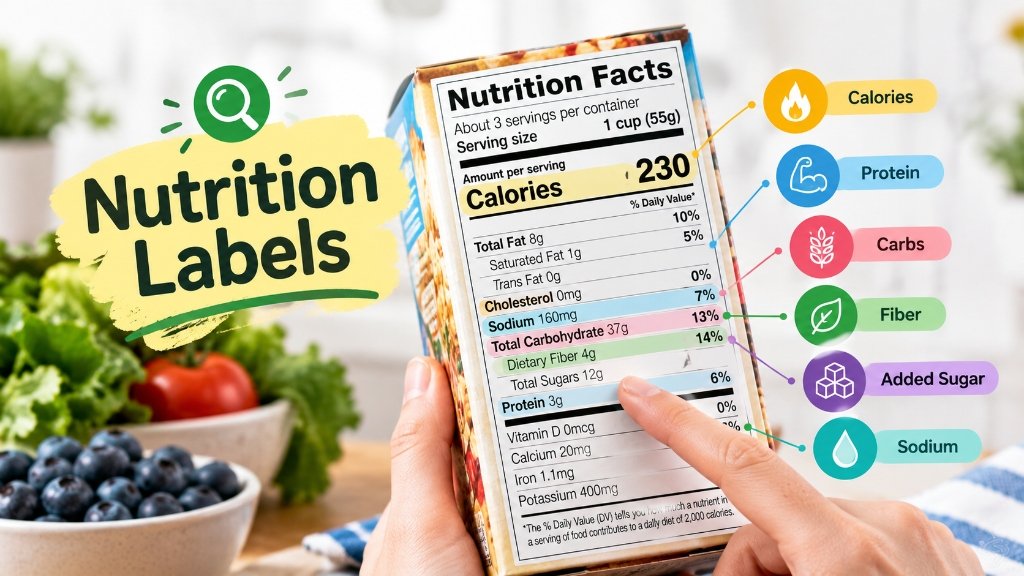
When reading any food label, look at these 7 items in order: 1. Serving Size, 2. Calories Per Serving, 3. Protein, 4. Dietary Fiber, 5. Added Sugar, 6. Saturated Fat, and 7. Sodium (% Daily Value). Use the 5/20 benchmark rule: 5% DV or less is low, while 20% DV or more is high.
You pick up a box of breakfast cereal, a protein bar, or a bag of baked snacks in the grocery aisle. The front packaging displays bold claims: "All Natural," "Heart Healthy," and "Energy Booster." Turn the box around, and you face a dense black-and-white grid crowded with grams, milligrams, and percentages.
Which numbers actually tell the truth about what you are eating? Which ones can you safely skip, and which ones hide sneaky surprises? Deciphering a food label takes less than fifteen seconds once you know where to cast your eyes first. In this practical guide, we break down how to read nutrition labels using a simple seven-point framework so you can buy food with clarity and confidence.
What Is a Nutrition Label?
A standard Nutrition Facts label is a standardized panel mandated on packaged foods and beverages. It gives shoppers an objective breakdown of a product's nutrient content per defined serving amount. While front-of-box claims are designed by marketing departments to trigger impulse purchases, the back panel follows strict regulatory standards.
The label separates quantitative facts from qualitative ingredients:
- Nutrition Facts panel: Measures the exact volume of calories, macronutrients, and selected micronutrients present in one measured serving.
- Ingredients list: Names every single component used in manufacturing, arranged in descending order by weight.
Using both pieces of information gives you the complete story. The numbers tell you how much energy and macronutrients you get, while the ingredient list reveals where those calories came from.
How to Read a Nutrition Label Step by Step
When mastering how to read nutrition labels, following a step-by-step checklist prevents confusion. Rather than scanning the entire panel randomly, follow this sequential 7-step process: Working from top to bottom keeps you from being fooled by clever packaging tricks:
- Check the stated serving size and servings per container.
- Look at calories per serving in relation to your daily budget.
- Inspect protein content for satiety and muscle maintenance.
- Check total carbohydrates and dietary fiber.
- Evaluate total sugars versus added sugars.
- Check total fat and saturated fat content.
- Check sodium and use the % Daily Value rule to spot extremes.
1. Check the Serving Size First
The serving size sits at the very top of the label for a crucial reason: every single number below it only applies to that exact quantity. If you skip this line, every other calculation you make about calories, carbs, or sugar will be inaccurate.
Why Serving Size Matters
Food manufacturers do not necessarily list the amount of food an average person actually sits down to eat. Instead, serving sizes reflect a reference amount customary to regulations. For instance, a small 70-gram bag of potato chips or a 500 ml bottle of iced tea often states that it contains two or 2.5 servings. If you consume the entire bag in one sitting, you have consumed double or triple what the label presents.
What Happens If You Eat Two Servings?
Look at how rapidly the arithmetic shifts when portion sizes increase. Suppose you buy a granola packet with the following label figures:
If you pour a standard cereal bowl of 80 g (2 servings):
Calories: 170 × 2 = 340 kcal | Added Sugar: 9 × 2 = 18 g
What seemed like a modest breakfast snack at 170 calories turns into a 340-calorie meal delivering nearly your entire daily sugar threshold before you even leave for work. Before judging any food, verify how many servings you realistically plan to eat.
Serving Size vs Portion Size
Keep the distinction clear in your mind: serving size is a standardized metric printed on a box for comparison; portion size is the physical amount of food you choose to put on your plate. If your portion does not match the printed serving, you must scale the numbers accordingly.
2. Look at Calories Per Serving
Calories measure the thermal energy your body extracts from food. Weight management, physical energy, and metabolic balance rely heavily on energy balance—consuming appropriate calories relative to what your body expends throughout the day.
However, judging a food strictly by its calorie count without context leads to poor dietary choices. For example, 150 calories of raw almonds provide monounsaturated fats, protein, and dietary fiber that keep you full for hours. In contrast, 150 calories of gummy candies consist of fast-digesting simple sugar that leaves you hungry thirty minutes later.
Comparing foods without checking their reference weights can also mislead shoppers. Look at this simple comparison:
| Packaged Item | Stated Serving Size | Calories Listed | Real Calories Per 100g |
|---|---|---|---|
| Brand A Energy Bar | 30 g | 130 kcal | 433 kcal |
| Brand B Energy Bar | 60 g | 220 kcal | 366 kcal |
At first glance, Brand A looks lower in calories (130 vs 220). But Brand A's manufacturer simply cut their bar size in half. Gram for gram, Brand A is actually more calorie-dense than Brand B. To know where your personal calorie intake fits into your daily routine, check your baseline daily calorie needs using our free TDEE calculator.
Want to know your exact daily maintenance calories?
Estimate your BMR and activity burn in seconds with our free tool.3. Check Protein, Carbohydrates, and Fiber
The middle portion of the label breaks down the primary macronutrients that supply energy to your muscles and organs. Examining the relationship between these three numbers gives you an accurate snapshot of nutritional quality.
Protein
Protein builds and repairs muscular tissues, produces essential enzymes, and stimulates satiety hormones like peptide YY. When reviewing a snack or meal replacement, check how many grams of protein it delivers per 100 calories. Foods offering 8 to 15 grams of protein per serving keep you satisfied between meals and support lean muscle retention, especially when monitoring your healthy BMI target.
Total Carbohydrates
Total carbohydrates include all forms of sugars, starches, and fiber present in the product. Carbohydrates are your body's preferred source of quick physical energy, but the type of carbohydrate determines how smoothly that energy is released into your bloodstream.
Dietary Fiber
Fiber is the non-digestible part of plant carbohydrates that slows digestion, nourishes beneficial gut bacteria, and prevents rapid spikes in blood sugar. Nutritionists recommend aiming for 25 to 35 grams of total dietary fiber per day. When evaluating breads, pastas, or grain cereals, look for at least 3 to 5 grams of dietary fiber per serving.
| Bread Type (1 Slice) | Total Carbs | Dietary Fiber | Net Digestible Carbs |
|---|---|---|---|
| Refined White Bread | 15 g | 0.5 g | 14.5 g |
| Sprouted 100% Whole Grain | 15 g | 4.0 g | 11.0 g |
Both bread slices contain exactly 15 grams of total carbohydrates, yet the whole grain bread offers eight times more dietary fiber, resulting in greater fullness and a gentler glycemic response.
4. Understand Sugar and Added Sugar
Modern nutrition labels make a distinct separation between Total Sugars and Added Sugars. This is one of the most beneficial changes made to regulatory food labels in recent years.
Total Sugar vs Added Sugar
Total sugar includes every gram of sugar in the product—both naturally occurring sugars and refined sweeteners introduced during manufacturing. Added sugars, in contrast, represent syrups, cane sugar, honey, agave, or high-fructose corn syrup incorporated during processing.
Why "0 g Added Sugar" Does Not Mean Sugar-Free
Whole milk, plain yogurt, and dried fruit naturally contain intrinsic sugars (such as lactose in dairy and fructose in fruit). A cup of plain dairy yogurt contains around 10 to 12 grams of natural sugar from milk lactose, with zero grams of added sugar. In contrast, fruit-flavored sweetened yogurt often carries 24 grams of total sugar, including 15 grams of added cane sugar. The plain yogurt offers valuable dairy nutrition; the flavored version behaves more like a dessert.
| Nutrient Line | Product A (Plain Oat Milk) | Product B (Flavored Oat Milk) |
|---|---|---|
| Total Sugars | 4 g | 16 g |
| Added Sugars | 0 g (0% DV) | 13 g (26% DV) |
Looking only at total sugars might lead you to think Product A still has sweetening ingredients. Checking the "Added Sugars" sub-line confirms that Product A contains zero introduced syrups, making it the superior everyday staple.
5. Understand Fat, Saturated Fat, and Trans Fat
Dietary fat is an essential macronutrient needed to absorb fat-soluble vitamins (A, D, E, and K), produce hormones, and protect nerve membranes. The historical trend of categorizing all fats as harmful has been replaced by an understanding of fat quality.
- Total Fat: Combines all fatty acids present in the serving. Fat provides 9 calories per gram, compared to 4 calories per gram for protein and carbohydrates.
- Saturated Fat: Primarily found in fatty meats, butter, palm oil, and coconut products. Health guidelines suggest limiting saturated fat to under 10% of total daily calories (roughly 20 grams per day on a standard 2,000-calorie diet).
- Trans Fat: Partially hydrogenated industrial oils created through artificial chemical processing. Trans fats elevate low-density lipoprotein (LDL) cholesterol while lowering beneficial HDL. Look for 0 g trans fat on the label, and confirm that "partially hydrogenated oil" does not appear anywhere in the ingredient list.
Monounsaturated and polyunsaturated fats (found in extra virgin olive oil, avocados, flaxseeds, and walnuts) frequently do not have mandatory dedicated sub-lines on basic labels, but you can infer their presence: subtract saturated and trans fat from total fat, and the remaining amount consists of beneficial unsaturated fats.
6. Check Sodium
Sodium is an essential electrolyte required for fluid regulation, cellular nerve conduction, and muscle contraction. However, because salt serves as a low-cost preservative and flavor enhancer, heavily packaged and ultra-processed foods are loaded with it.
The general recommended daily limit for sodium is 2,300 mg (equivalent to roughly one teaspoon of table salt). Many ready-to-eat frozen entrees, canned soups, and salad dressings pack between 800 mg and 1,400 mg in a single serving—more than half of your daily allowance in one sitting.
Sodium Benchmark Tip: Look for products with less than 140 mg of sodium per serving to qualify as "low sodium." When comparing two brands of canned beans, tomatoes, or broth, choosing the lower-sodium can easily saves you 500+ milligrams of excess salt daily.
7. Learn How to Use % Daily Value
The column running along the right side of the nutrition label is marked % Daily Value (% DV). This percentage tells you how much a single serving contributes toward your total recommended daily intake for that nutrient, based on an average 2,000-calorie daily baseline.
You do not need to memorize complex medical formulas to use this column effectively. Memorize this straightforward 5/20 guideline established by health educators:
| % Daily Value | What It Means | Nutrients You Want Low | Nutrients You Want High |
|---|---|---|---|
| 5% DV or less | The food is LOW in this nutrient | Saturated Fat, Sodium, Added Sugars | — |
| 10% to 19% DV | The food provides a MODERATE amount | Neutral balance | Good everyday contribution |
| 20% DV or more | The food is HIGH in this nutrient | Avoid excess here | Dietary Fiber, Calcium, Vitamin D, Iron |
This single rule makes shopping effortless. If a canned soup shows 38% DV for sodium, you immediately know it is extremely high in salt. If a grain cereal shows 24% DV for dietary fiber, you know it is an excellent source of prebiotic roughage.
How to Read Nutrition Labels When Comparing Two Products
Putting these principles to work is easiest with a realistic comparison. Knowing how to read nutrition labels side by side reveals which food genuinely supports your health goals. Imagine you are choosing between two snack bars on the grocery shelf:
| Nutrient Metric | Snack Bar A (Cereal Fruit Bar) | Snack Bar B (Nut & Seed Bar) |
|---|---|---|
| Serving Weight | 40 g | 40 g |
| Calories | 160 kcal | 190 kcal |
| Total Fat | 3 g (4% DV) | 12 g (15% DV) |
| Saturated Fat | 1 g (5% DV) | 2 g (10% DV) |
| Sodium | 180 mg (8% DV) | 75 mg (3% DV) |
| Total Carbohydrates | 31 g (11% DV) | 14 g (5% DV) |
| Dietary Fiber | 1 g (4% DV) | 5 g (18% DV) |
| Total Sugars | 17 g | 5 g |
| Added Sugars | 14 g (28% DV) | 2 g (4% DV) |
| Protein | 2 g | 7 g |
An uninformed buyer might pick Snack Bar A simply because it has 30 fewer calories (160 vs 190). But examine the complete nutritional profile:
- Snack Bar A gets almost all its calories from 14 grams of added sugar (nearly a third of your daily threshold), with only 1 gram of fiber and 2 grams of protein. It will cause a quick blood sugar spike and leave you hungry.
- Snack Bar B has slightly higher calories because of wholesome nuts and seeds. Yet it delivers 5 grams of dietary fiber, 7 grams of protein, half the sodium, and only 2 grams of added sugar.
Snack Bar B is distinctly the more satiating, nutrient-dense choice. Always look past the raw calorie number to see what fuels those calories.
Ingredients List vs Nutrition Facts: What Is the Difference?
Always pair the Nutrition Facts panel with a quick glance at the ingredients list. Food laws require manufacturers to list every ingredient in descending order by weight. The first three to five ingredients make up the vast bulk of what you are actually eating.
Watch out for these common manufacturing tricks:
- Sugar splitting: Manufacturers often use three or four different names for sweeteners—such as brown rice syrup, cane juice crystals, barley malt, and dextrose. Because each sweetener is listed individually by weight, they appear further down the ingredients list rather than at the top.
- Short, recognizable lists: If the first ingredients are whole oats, almonds, and dried apples, you are holding real food. If the list reads like a laboratory inventory of modified starches, emulsifiers, and artificial flavor enhancers, the item is ultra-processed.
- Whole grain verification: Look for the word "whole" preceding the grain (such as "whole wheat flour" or "whole grain oats"). Terms like "wheat flour," "unbleached enriched flour," or "multigrain" often simply mean standard refined white flour tinted with caramel coloring.
5 Common Mistakes When Learning How to Read Nutrition Labels
Even health-conscious shoppers fall into predictable traps. Here are five missteps you can easily avoid:
- Assuming the container equals one serving: Always verify "Servings Per Container." A 16-ounce beverage or medium bag of chips frequently counts as two or three servings.
- Judging a food solely by its calorie number: A 100-calorie pack of cookies lacks protein, fiber, and micronutrients, whereas 200 calories of Greek yogurt provides sustained fuel.
- Confusing total sugar with added sugar: Natural sugars in plain fruit and dairy bring vitamins and minerals. Added sugars bring empty calories.
- Trusting front-of-package buzzwords: Terms like "Gluten-Free," "Organic," and "Keto-Friendly" describe ingredients or production methods, not whether a food is balanced or healthy. Organic sugar is still sugar.
- Comparing foods with unequal serving weights: One cereal may set its serving size at 30 grams while another sets it at 55 grams. Always calculate or normalize to comparable weights before choosing.
A 30-Second Nutrition Label Checklist
📋 Quick In-Store Scanning Checklist
Before placing any packaged food into your grocery cart, run through these six quick checks:
Practical Calculation Example: What If You Eat 1.5 Servings?
Let's run through a realistic scenario. You prepare a frozen chicken and vegetable pasta bowl for dinner. The label states:
- Serving size: 1 cup (220 g)
- Servings per container: About 1.5
- Calories: 280 kcal
- Protein: 16 g
- Sodium: 580 mg (25% DV)
- Added sugar: 2 g
You eat the entire tray (1.5 servings). Here is how your true nutritional intake adds up:
Total Protein: 16 × 1.5 = 24 grams
Total Sodium: 580 × 1.5 = 870 mg (38% DV)
Total Added Sugar: 2 × 1.5 = 3 grams
Notice how sodium jumped from a manageable 580 mg to a substantial 870 mg. If you track your daily hydration and electrolyte balance, balance this higher-sodium meal by drinking plenty of fluids. You can estimate your personal hydration targets using our free water intake calculator.
Frequently Asked Questions
What is the most important thing to look at on a nutrition label?
The serving size is the most critical starting point. Every number on the panel—from calories to sodium—describes only that specific quantity. If you consume double the stated serving, you must multiply all subsequent nutritional figures by two.
Should I focus on calories or ingredients?
You should check both. The Nutrition Facts panel tells you the quantitative energy and nutrient density, while the ingredients list reveals food quality and source materials. A product with moderate calories can still contain low-quality refined oils or multiple forms of added sugars.
What is a good amount of added sugar per serving?
Aim for foods with 5 grams or fewer of added sugar per serving, and under 5% Daily Value. Health agencies recommend keeping daily added sugars under 25 grams for women and under 36 grams for men.
What does % Daily Value (% DV) mean?
The % Daily Value indicates how much a single serving contributes toward your total recommended daily intake based on a standard 2,000-calorie reference diet. A general rule is: 5% DV or less is low, and 20% DV or more is high.
Is high protein always better on a food label?
Not necessarily. Many packaged foods boast high protein claims on the front box while packing excessive saturated fats, sodium, or artificial sweeteners. Always inspect the full nutrition panel to verify the overall calorie-to-protein ratio.
Why do manufacturers use small serving sizes?
Regulations require serving sizes to reflect customary consumption amounts, but manufacturers often pick the smallest allowable baseline. This makes calories, fats, and sugars look surprisingly low at first glance until you realize the container holds three or four servings.
Final Takeaway
Learning how to read nutrition labels gives you lifelong control over your nutritional health. You do not need a degree in dietetics to make smart decisions at the supermarket. By focusing on seven key metrics—serving size, calories, protein, fiber, added sugars, saturated fat, and sodium—you can evaluate any packaged food in seconds. Always use the 5/20 Daily Value rule to spot extremes, and check the ingredient list to ensure whole foods come first.
Curious about how packaged foods fit into your broader daily health targets? Use our free health tools to calculate your personal metrics:
- Calorie & TDEE Calculator — Find your exact maintenance and deficit targets.
- BMI Calculator — Check your baseline body mass index benchmark.
- Water Intake Calculator — Estimate your ideal daily hydration needs.
🔬 External Authoritative Sources & Guidelines
- U.S. Food and Drug Administration (FDA) — How to Understand and Use the Nutrition Facts Label.
- USDA FoodData Central — Official Nutritional Databases and Food Composition Tables.
- Centers for Disease Control and Prevention (CDC) — Dietary Guidelines and Public Nutrition Strategies.
- American Heart Association (AHA) — Understanding Food and Nutrition Labels for Cardiovascular Health.
💡 Key Takeaways
Reading nutrition labels effectively begins with serving size. Prioritize high protein and fiber while screening out excessive sodium and added sugars. Use the 5% (low) and 20% (high) % Daily Value rule to compare brands quickly without second-guessing your choices.