
A Working Days Calculator determines the net number of billable or office business days between two specific calendar dates. By filtering out Saturday and Sunday weekends along with statutory public holidays, it helps project managers, HR professionals, and employees calculate exact project schedules, leave balances, and payroll days accurately.
Why Calculating Business Days Accurate Matters
A calendar month usually spans 30 or 31 calendar days, but your team rarely works all 30 days. Weekends account for 8 to 10 days each month, and national or regional public holidays remove additional dates from your office schedule.
Using raw calendar days to estimate software delivery dates, manufacturing turnaround times, or legal response windows causes artificial delays. When you calculate business days, you establish realistic project timelines that align with actual office hours.
Whether you manage employee attendance, organize shift planning, or coordinate international trade logistics, a dedicated workday calculator prevents scheduling errors and simplifies project delivery planning.
How to Calculate Working Days Between Dates
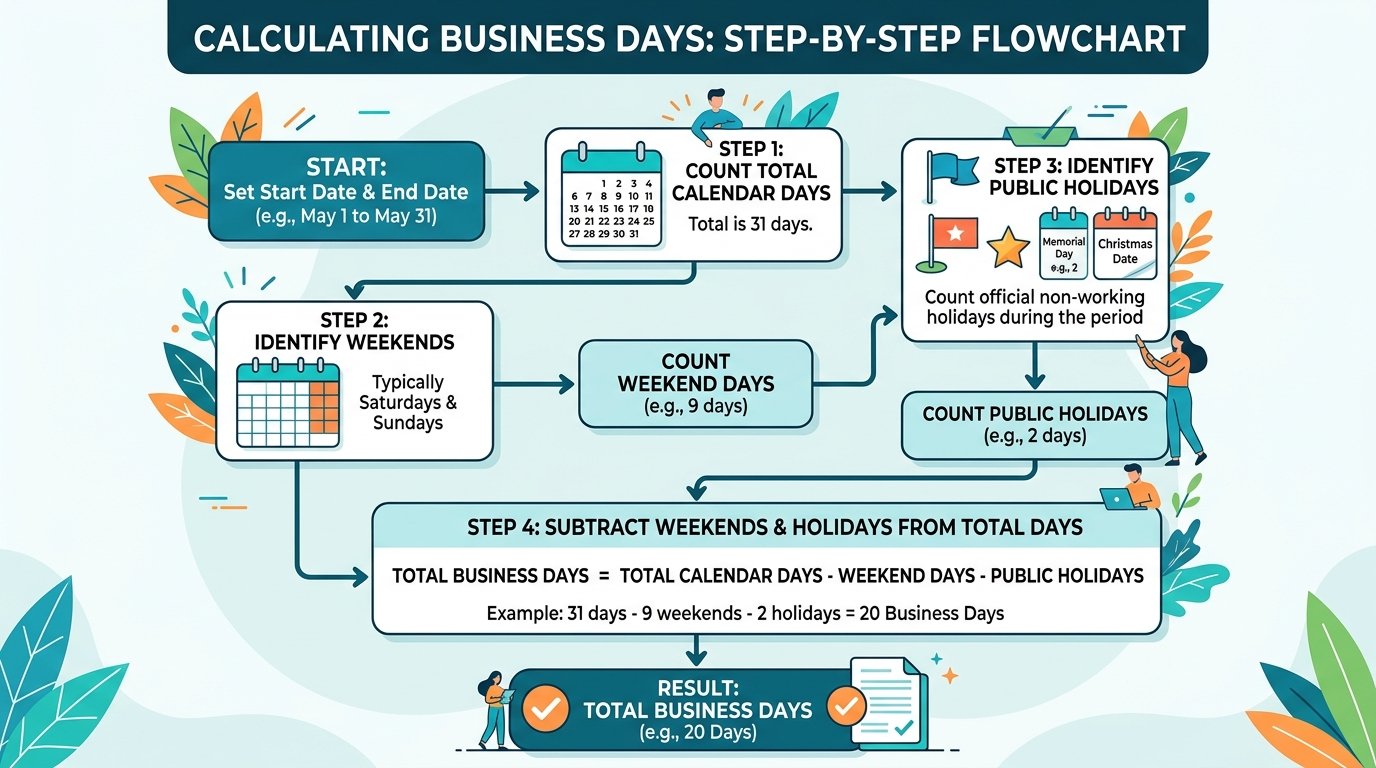
To calculate the exact number of working days between dates manually, follow these core steps:
- Determine Total Calendar Days: Count every day starting from your start date through your target end date.
- Identify Weekend Days: Count the number of Saturdays and Sundays falling within that date interval.
- Identify Public Holidays: List any official corporate or statutory public holidays occurring on weekdays during that timeframe.
- Apply the Workday Formula: Subtract weekend days and weekday holidays from total calendar days.
Step-by-Step Calculation Example
Let's run through a practical workplace scenario to see how a business calendar calculator functions in real life.
Suppose your company begins a software development project on Monday, October 5, 2026, with a promised completion date of Friday, October 30, 2026.
- Total Calendar Span: 26 days (including start and end dates).
- Saturdays & Sundays: 8 weekend days (Oct 10, 11, 17, 18, 24, 25, 31).
- Public Holidays: 1 official holiday (e.g., Dussehra / regional holiday on Oct 20).
Applying our formula:
( ext{Working Days} = 26 - 8 - 1 = 17 ext{ net business days})
Instead of promising 26 days of effort to your client, your actual capacity is 17 office working days (or 136 total working hours assuming an 8-hour workday).
Standard Work Week Formats Across Industries
Work schedules vary significantly depending on industry standards and geographic region:
| Schedule Type | Active Workdays | Off Days | Common Use Cases |
|---|---|---|---|
| 5-Day Standard | Monday – Friday | Saturday, Sunday | Corporate offices, IT, banking, government |
| 6-Day Commercial | Monday – Saturday | Sunday | Retail, manufacturing, construction, healthcare |
| Middle East Work Week | Sunday – Thursday | Friday, Saturday | Gulf region businesses (UAE, Saudi Arabia, Qatar) |
Handling Complex Workday Exceptions & Leap Years
Calculating business calendar days accurately requires recognizing localized edge cases. Company work schedules often adjust around regional holidays, leap year calendars, or unexpected office closures.
1. Leap Year Impacts on Annual Workday Counts
During a leap year, February contains 29 calendar days instead of 28. If February 29 falls on a weekday (Monday through Friday), the annual count of billable working hours increases by 8 hours. Over an entire leap year, total business days typically range between 261 and 262 days, compared to 260 or 261 days during a regular non-leap year.
2. Floating & Regional Public Holidays
While fixed-date public holidays (like Independence Day or New Year's Day) are straightforward to track, religious and lunar holidays shift dates annually. Also, if a statutory public holiday falls on a Sunday, many international corporate policies grant an observed holiday on the following Monday, which reduces the active business day count for that week.
3. Pro-Rating Employee Leave & Accruals
Human resource teams calculate earned leave accruals based on actual days worked. If an employee joins mid-month on Wednesday, October 14, calculating exact weekdays between dates ensures that pro-rated monthly allowances, health insurance benefits, and retirement contributions are credited without discrepancies.
Key Uses for a Business Days Calculator
Using an accurate weekdays calculator assists across multiple operational functions:
1. HR & Payroll Management
HR managers calculate monthly payroll based on actual working days attended. Knowing the exact count of weekdays between dates ensures accurate calculation of pro-rated salaries, overtime hours, and leave encashment calculations.
2. Project Timeline Planning
Gantt charts and project management tools depend on workdays rather than calendar days. If a milestone requires 15 business days, calculating calendar dates properly accounts for weekends and holiday interruptions.
3. Financial Settlement & Banking Deadlines
Banking transactions, check clearances, and stock trade settlements (T+1 or T+2) operate strictly on business days. Calculating delivery times accurately prevents unnecessary payment default warnings.
Related Date and Time Tools
Need to calculate ages, time durations, or schedule intervals? Explore our free specialized utility calculators:
- Date Difference Calculator
- How to Calculate Exact Age & Dates
- Time Duration Calculator (Hours & Minutes)
- All Date & Time Tools
🌐 External Scientific References & Authoritative Sources
- ISO 8601 Standard — International Date, Time & Business Day Calculation Standards.
- NIST Special Publication 800-63B — Digital Identity & Password Entropy Guidelines.
- International Monetary Fund (IMF) — Foreign Exchange Rate Data & Financial Standards.
Frequently Asked Questions
Count the total number of calendar days between your start date and end date, then subtract Saturday and Sunday weekend days as well as any official public holidays falling within that date interval.
Most workday calculators offer options to include or exclude the start and end dates depending on your payroll or contract guidelines. Standard HR practices typically count both start and end dates as active workdays.
An average calendar month contains 20 to 22 working days based on a standard 5-day work week, assuming no additional statutory public holidays occur during that month.
For 6-day work schedules or custom shift planning (where Saturday is a half-day or full workday), adjust your weekend filter to subtract only Sundays and customized company holidays.
Project timelines and client deliverables depend on actual billable working hours rather than total calendar days. Accounting for holidays prevents missed deadlines and billing discrepancies.
Key Takeaways
Calculating working days accurately keeps your project timelines realistic, your payroll compliant, and your delivery promises dependable. Filter out weekends and official holidays to plan every business quarter with confidence.