
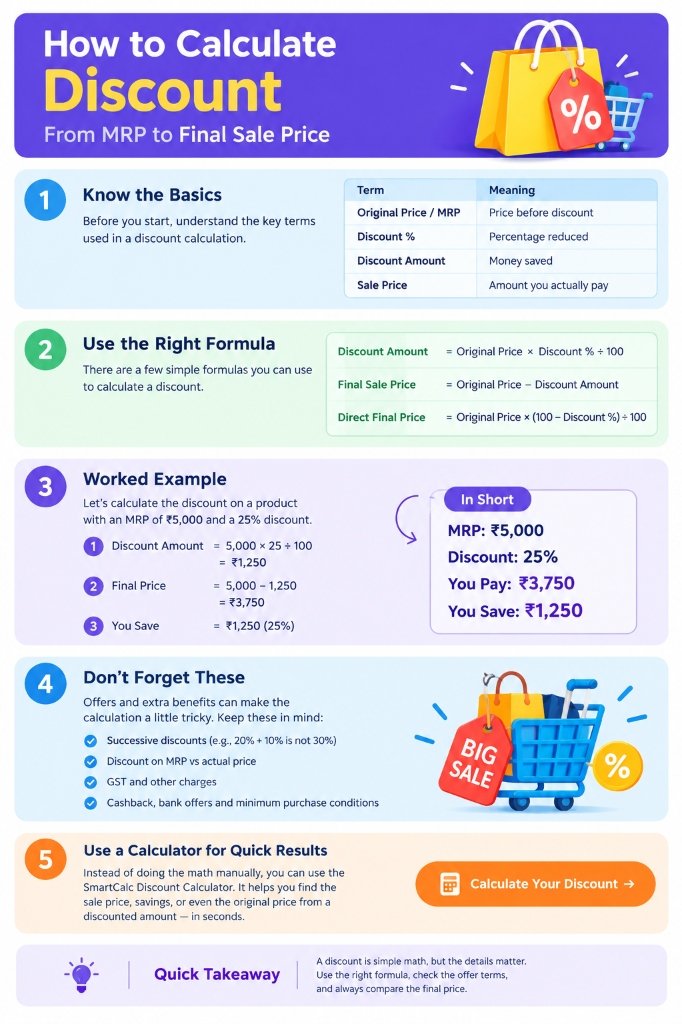
To calculate a discount, multiply the original price by the discount percentage and divide by 100. Subtract the discount amount from the original price to find the final sale price.
Example: ₹2,000 at 20% off
• Discount = ₹2,000 × 20 ÷ 100 = ₹400
• Final price = ₹2,000 − ₹400 = ₹1,600
• You save = ₹400
Want to skip manual math? Use the free SmartCalc Discount Calculator to calculate the sale price or find the original price from a discounted amount.
Seeing a bright store tag claiming "Flat 40% Off" gets attention fast. But standing in an aisle or reviewing an online cart, figuring out the actual cash you spend can be confusing. Does 30% off bring a ₹2,499 item inside your budget? What happens when a website advertises 20% off plus an extra 10% coupon?
Calculating discounts accurately helps you steer clear of impulse purchases and identify genuine price cuts. Here is a clear walk-through of every formula, step-by-step method, and real rupee scenario you need.
What Is a Discount?
A discount is a reduction in the regular price of an item or service. Sellers use discounts to move stock, while buyers use them to save money.
Keep these basic terms clear in your mind:
| Term | Meaning |
|---|---|
| Original Price | Price before discount (often printed as MRP). |
| Discount % | Percentage reduced from the starting price. |
| Discount Amount | Money saved in rupees. |
| Sale Price | Amount you actually pay. |
Discount Formula
You can calculate any discount using three simple formulas. Choose the one that fits what you want to know first.
Discount Amount Formula
Use this when you want to know your exact rupee savings:
Final Sale Price Formula
Subtract your rupee discount from the starting price:
Direct Final Price Formula
If you only want the checkout total without calculating the discount first, use the remaining percentage. For instance, at 25% off, you pay the remaining 75%:
Example
MRP = ₹5,000 | Discount = 25%
• Discount: ₹5,000 × 25 ÷ 100 = ₹1,250
• Final price: ₹5,000 − ₹1,250 = ₹3,750
• Direct method: ₹5,000 × (100 − 25) ÷ 100 = ₹5,000 × 0.75 = ₹3,750
How to Calculate Discount Step by Step
Follow these five steps to work out prices cleanly without mistakes:
Step 1 — Find the Original Price
Check the product tag or detail box. In India, this is usually the Maximum Retail Price (MRP). Note down the starting number before any taxes or shipping fees.
Step 2 — Find the Discount Percentage
Check the promotion terms. Common retail discounts include round numbers like 10% off, 25% off, 40% off, or 50% off.
Step 3 — Calculate the Discount Amount
Divide the percentage by 100, then multiply by the original price. For 40% off on ₹1,500, multiply ₹1,500 by 0.40 to get ₹600.
Step 4 — Subtract the Discount
Subtract the discount from the original price: ₹1,500 − ₹600 = ₹900. That gives you the net sale price.
Step 5 — Check Your Savings
The discount amount is the actual rupee saving before other charges apply. If you need to check tax additions, our sales tax and GST calculator helps verify your invoice.
How to Calculate Discount Percentage
To find the percentage reduction when you know the old and new prices, use this formula:
Example
MRP = ₹4,000 | Sale Price = ₹3,000
• Savings: ₹4,000 − ₹3,000 = ₹1,000
• Discount: ₹1,000 ÷ ₹4,000 × 100 = 25%
For broader percentage math, explore our free percentage calculator.
How to Calculate Discount on MRP
Under Indian regulations, goods carry a Maximum Retail Price (MRP). Retailers cannot charge above MRP, but they often sell below it during sales.
MRP Example
MRP: ₹2,499 | Discount: 30%
• Discount amount: ₹2,499 × 30 ÷ 100 = ₹749.70
• Final price: ₹2,499 − ₹749.70 = ₹1,749.30
Keep in mind: Always verify the printed MRP on the box rather than trusting crossed-out online prices. Some sellers mark up base prices before sales so an everyday rate looks like a deep discount.
Is 20% + 10% Discount Really 30%?
No. A 20% discount followed by another 10% discount is 28% off, not 30%.
Stacked offers apply in sequence. The second discount percentage applies only to the reduced price, not the original starting total. Look at how this works on ₹1,000:
- Original price: ₹1,000
- 20% off: ₹1,000 → ₹800 (saves ₹200)
- Additional 10% off: 10% of ₹800 is ₹80 → ₹720
- Total saving: ₹1,000 − ₹720 = ₹280
- Actual discount: 28% (not 30%)
You can calculate two successive discounts with this formula:
For 20% and 10%:
20 + 10 − (20 × 10 ÷ 100) = 30 − 2 = 28%.
How to Calculate Successive Discounts
Successive discounts are calculated one after another. The second percentage applies to the reduced price, not the original price. This table shows what you actually save on stacked promotions:
| First Discount | Second Discount | Actual Combined Discount |
|---|---|---|
| 10% | 10% | 19% |
| 20% | 10% | 28% |
| 30% | 10% | 37% |
| 40% | 20% | 52% |
| 50% | 20% | 60% |
How to Find the Original Price After a Discount
If you know what you paid and the discount percentage you received, work backward to find the original list price using this reverse discount formula:
Reverse Example
You paid ₹1,600 after a 20% discount.
• Remaining fraction: 1 − 0.20 = 0.80
• Original price: ₹1,600 ÷ 0.80 = ₹2,000
• Saving = ₹400 | Sale price = ₹1,600
To run reverse calculations automatically, use our free discount calculator. Also see our guides on percentage increases and profit margin calculations.
How to Calculate Discount in Rupees
Converting percentage tags directly into rupee amounts makes comparing store deals much simpler. Here is what standard discounts save on a ₹5,000 item:
- 10% off ₹5,000: ₹500 saved → You pay ₹4,500
- 20% off ₹5,000: ₹1,000 saved → You pay ₹4,000
- 25% off ₹5,000: ₹1,250 saved → You pay ₹3,750
- 50% off ₹5,000: ₹2,500 saved → You pay ₹2,500
Mental Math Rule: To find 10% off, shift the decimal point one place to the left. On ₹3,000, 10% is ₹300. For 20%, double that number (₹600). For 5%, take half of it (₹150). You can combine these in your head in seconds.
How Discounts Work During Diwali and Festive Sales
Festive sales bring exciting banner claims, but retail offers often combine multiple layers with specific conditions:
- 30% off + 10% bank discount: These are successive discounts. On a ₹10,000 item, 30% drops it to ₹7,000. The 10% bank cut takes 10% of ₹7,000 (₹700), leaving ₹6,300. You save ₹3,700 (37%), not 40%.
- Flat ₹2,000 off coupon vs 20% discount: On a ₹15,000 order, 20% saves ₹3,000, making percentage better. On an ₹8,000 cart, 20% saves ₹1,600, making the flat ₹2,000 voucher give greater savings.
- Capped bank discounts: A banner claiming "10% instant card discount" often has fine print saying "up to ₹750." On a ₹20,000 TV, 10% would be ₹2,000, but the cap limits your savings to ₹750 (just 3.75%).
- "Up to 70% off" tags: Most items carry modest 10% to 20% discounts, while only a small number of older items qualify for 70%.
Discount vs Cashback: What's the Difference?
Retail promotions often present discounts and cashback as equal savings, but they differ in how you receive the benefit:
| Feature | Discount | Cashback |
|---|---|---|
| Purchase Price | Reduces purchase price immediately. | Money returned later. |
| Visibility | Usually visible at checkout. | Often credited afterward. |
| Ease of Use | Easy to calculate immediately. | May have conditions. |
| Amount Paid | Reduces amount paid right away. | May depend on payment method. |
Common Discount Calculation Mistakes
Keep these six practical mistakes in mind to avoid spending more than you planned:
- Adding successive discounts: 20% + 10% does not equal 30%. Always calculate stacked discounts in sequence.
- Using the wrong original price: Make sure you use the genuine starting price rather than an inflated base tag.
- Confusing discount amount with final price: A ₹400 discount on ₹2,000 means you pay ₹1,600, not ₹400.
- Treating cashback as an instant discount: Cashback in an app wallet is not the same as money deducted at checkout.
- Ignoring minimum-spend conditions: Spending extra on goods you do not need to unlock a ₹500 coupon usually costs more than it saves.
- Assuming the biggest percentage means the best deal: Compare the final amount you pay, not just the advertised percentage.
Discount Calculation Examples
Here are five worked examples covering everyday shopping situations:
• Discount: ₹1,000 × 0.10 = ₹100
• Final Price: ₹1,000 − ₹100 = ₹900
• Discount: ₹2,500 × 0.25 = ₹625
• Final Price: ₹2,500 − ₹625 = ₹1,875
• Discount: ₹10,000 × 0.40 = ₹4,000
• Final Price: ₹10,000 − ₹4,000 = ₹6,000
• First discount: 20% of ₹4,000 = ₹800 → Subtotal = ₹3,200
• Second discount: 10% of ₹3,200 = ₹320 → Final Price = ₹2,880
• Total savings: ₹1,120 (actual 28% off)
• Sale price = ₹2,400 after 20% off
• Original price = ₹2,400 ÷ (1 − 0.20) = ₹2,400 ÷ 0.80 = ₹3,000
Use the SmartCalc Discount Calculator
If you don't want to calculate discounts manually, the SmartCalc Discount Calculator can calculate the sale price and savings from an original price and discount percentage. It also includes a reverse-discount option for finding the original price from a discounted price.
Want to calculate your exact sale price right now?
Find discounts, rupee savings, and reverse prices instantly.Frequently Asked Questions About Calculating Discounts
Multiply the original price by the discount percentage and divide by 100 to get the discount amount. Subtract that number from the original price to find your final sale price.
Discount % = ((Original Price − Sale Price) ÷ Original Price) × 100. If an item drops from ₹4,000 to ₹3,000, you save ₹1,000. Dividing ₹1,000 by ₹4,000 gives 0.25, which is a 25% discount.
Multiply the price by 0.20 to find your savings, then subtract it. Or multiply directly by 0.80 to get the final bill. On ₹2,000, 20% off saves ₹400 and leaves ₹1,600 to pay.
Multiply the printed Maximum Retail Price (MRP) by the discount percentage and divide by 100. Subtract this discount figure from the MRP to get your counter total.
No. Two successive discounts of 20% and 10% equal 28% off, not 30%. The second 10% discount applies only to the reduced price after the first 20% cut.
Divide the discounted price by (1 minus the discount percentage divided by 100). If you paid ₹1,600 after 20% off, divide ₹1,600 by 0.80 to get the original ₹2,000 price.
Multiply the rupee figure by the discount percentage and divide by 100. For quick mental math, find 10% by shifting the decimal one spot left, then double it for 20%.
Use the formula: Combined Discount = A + B − (A × B ÷ 100), where A and B are the two discount rates. Or calculate the first discount, then apply the second rate to the new subtotal.
Use mental math shortcuts: find 10% by shifting the decimal one spot to the left, then scale up. Or subtract the discount percentage from 100 and multiply by the remaining decimal.
Key Takeaways: The Smart Way to Calculate Discounts
- Core Formula: Multiply original price by discount percent and divide by 100 to get rupee savings; subtract from starting price for the final checkout cost.
- The Complement Shortcut: Calculate 30% off by multiplying directly by 0.70 (the remaining 70%).
- Successive Discounts Are Not Additive: 20% off plus 10% off is a 28% net cut, not 30%. The second reduction applies only to the already-lowered subtotal.
- MRP Regulations: In India, selling above the Maximum Retail Price is prohibited under the Legal Metrology Act; retail discounts should always be calculated from legitimate list prices.
- Taxation Order: In standard retail and GST rules, promotional discounts are deducted from the list subtotal before sales taxes or GST are assessed.
- Instant Verification: Use the free SmartCalc Discount Calculator to compute sale totals and reverse pre-sale figures with zero guesswork.
- Ministry of Consumer Affairs, Food and Public Distribution, Government of India. (2011). The Legal Metrology (Packaged Commodities) Rules, 2011 (as amended). Rule 18: Provisions relating to retail sale price declaration and prohibition of selling above MRP. Available at: consumeraffairs.nic.in
- Federal Trade Commission (FTC). (2023). Guides Against Deceptive Pricing (16 CFR Part 233). Title 16 — Commercial Practices, Chapter I — Federal Trade Commission. Available at: ftc.gov/guides-against-deceptive-pricing
- Central Board of Indirect Taxes and Customs (CBIC), Ministry of Finance, India. (2017). Central Goods and Services Tax Act, 2017 — Section 15: Value of Taxable Supply (Treatment of pre-sale and post-sale discounts). Available at: cbic.gov.in
- European Parliament & Council of the European Union. (2019). Directive (EU) 2019/2161 (Omnibus Directive) on Better Enforcement and Modernisation of Union Consumer Protection Rules: Article 6a (Price Reduction Announcements). Official Journal of the European Union. Available at: eur-lex.europa.eu
- Kahneman, D., & Tversky, A. (1979). Prospect Theory: An Analysis of Decision under Risk. Econometrica, 47(2), 263–291. Discussion of reference pricing and loss aversion in consumer price framing. Available at: jstor.org/stable/1914185
- Chen, H. A., Marmorstein, H., Tsiros, M., & Rao, A. R. (2012). When More Is Less: The Impact of Base Value Neglect on Consumer Preferences for Bonus Packs over Price Discounts. Journal of Marketing, 76(4), 64–77. Available at: Journal of Marketing (Sage)
- Grewal, D., Monroe, K. B., & Krishnan, R. (1998). The Effects of Price-Comparison Advertising on Buyers' Perceptions of Acquisition Value, Transaction Value, and Behavioral Intentions. Journal of Marketing, 62(2), 46–59. Available at: Journal of Marketing (1998)
- Diamond, W. D., & Campbell, L. (1989). The Frame of Reference for Sales Promotions: An Approach to Understanding Information Processing of Discounts. Advances in Consumer Research, 16, 177–185. Available at: acrwebsite.org
- Hardesty, D. M., & Bearden, W. O. (2003). Consumer Evaluations of Different Promotion Types and Price Presentation Formats. Journal of Retailing, 79(1), 17–25. Available at: Journal of Retailing (ScienceDirect)
- Advertising Standards Council of India (ASCI). (2023). Code for Self-Regulation in Advertising — Guidelines for Qualification of Brand Claims and Disclaimers in Price and Discount Promotions. Available at: ascionline.in