
Learn how to calculate profit margin for small business and e-commerce. Understand gross, net, and operating profit margin formulas with real numerical examples.
Running a business without knowing your margins is like driving with your eyes closed. Many business owners focus entirely on top-line revenue, believing that higher sales automatically translate to a healthy company. If you want to evaluate your performance, you must know how to calculate profit margin percentages to find the actual cash left after expenses.
A basic understanding of business finance reveals that not all sales are equal. By checking our profit percentage calculator numbers and applying standard financial ratio parameters, you can identify whether your pricing strategy is sustainable or draining your reserves.
Understanding Profit Margin vs. Markup
Many new retail managers confuse profit margin with markup. While both express profit as a percentage of value, their reference points are completely different. Margin evaluates profit relative to the selling price, while markup evaluates profit relative to the cost price of goods.
For example, if you buy an item for ₹100 (cost price) and sell it for ₹150 (selling price), your profit is ₹50. Your markup is 50% (₹50 profit / ₹100 cost), but your profit margin is 33.3% (₹50 profit / ₹150 selling price). Miscalculating this relation is a common pricing strategy error that can impact your cash flow. If you need to verify your numbers, an online margin calculator is the best way to do so.
Types of Business Profit Margin
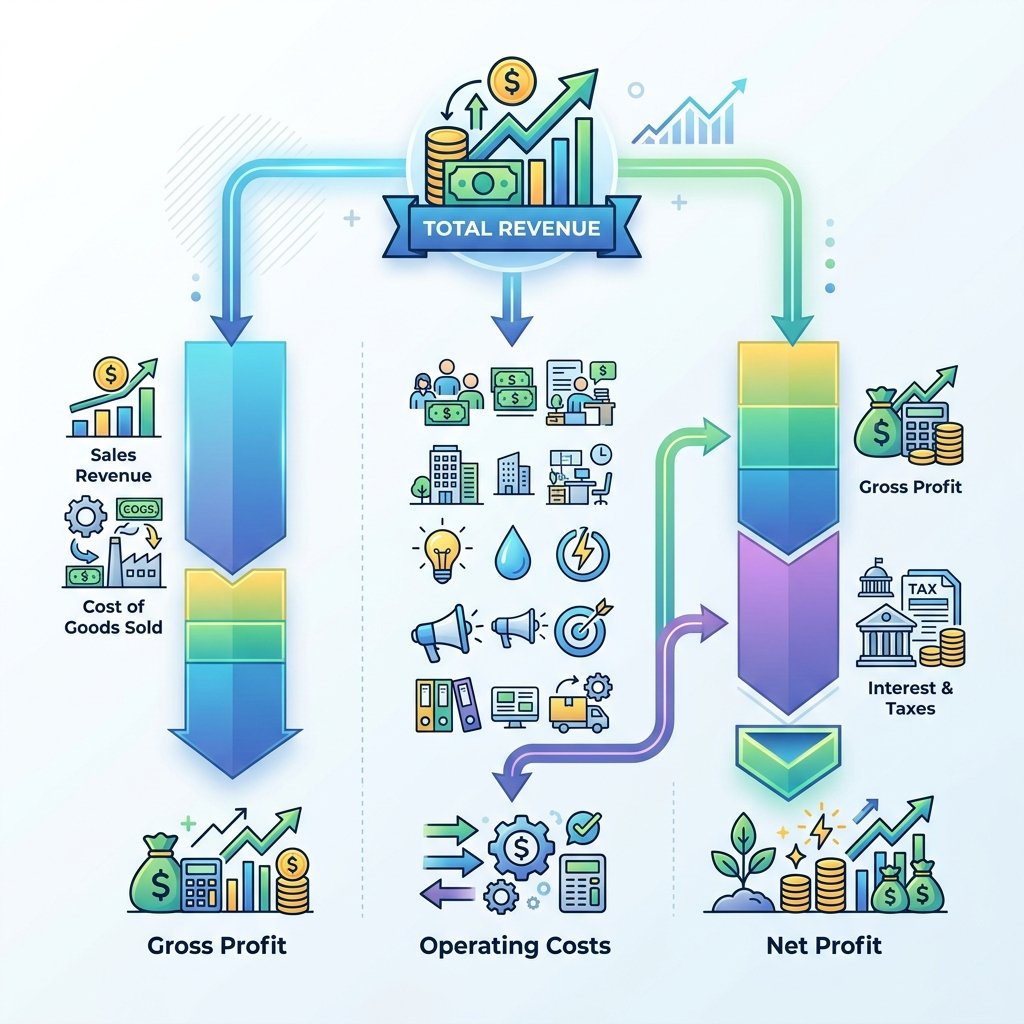
To evaluate a company's financial ratio health, accountants break profit down into three distinct tiers. Each tier offers a different level of detail about your operating efficiency:
1. Gross Profit Margin
This metrics shows the percentage of revenue remaining after subtracting direct product manufacturing costs. It evaluates the raw efficiency of your ecommerce pricing and direct retail margin margins without administrative overhead.
2. Operating Profit Margin
This accounting formula factors in both direct product costs and daily operating expenses. It includes costs like office rent, advertising budgets, administrative payroll, and equipment wear.
3. Net Profit Margin
This is the ultimate bottom-line financial ratio. It represents the percentage of revenue left after all expenses have been deducted—including debt interest, overhead bills, depreciation, and state taxes.
Margin vs. Markup Comparison Table
When modeling your pricing, you can refer to a standard margin vs markup conversion sheet. It shows how the same transaction translates into different percentages:
| Cost Price | Selling Price | Markup (%) | Gross Profit Margin (%) | Markup Multiplier |
|---|---|---|---|---|
| ₹100 | ₹125 | 25.0% | 20.0% | 1.25x |
| ₹100 | ₹150 | 50.0% | 33.3% | 1.50x |
| ₹100 | ₹200 | 100.0% | 50.0% | 2.00x |
| ₹100 | ₹300 | 200.0% | 66.7% | 3.00x |
Practical Profit Margin Example
Let's run a calculation for an online store to calculate net profit and gross returns:
- Total Sales Revenue: ₹5,00,000
- Cost of Goods Sold (COGS): ₹2,00,000
- Operating Expenses (Rent + Ads): ₹1,50,000
- Taxes & Interest Deductions: ₹50,000
First, we calculate gross profit: ₹5,00,000 − ₹2,00,000 = ₹3,00,000. Applying the gross profit margin formula gives a 60% gross margin (₹3,00,000 / ₹5,00,000).
Next, we calculate net profit: Gross profit (₹3,00,000) minus operating expenses (₹1,50,000) and taxes (₹50,000) = ₹1,00,000. Applying the net profit margin equation gives a 20% net margin (₹1,00,000 / ₹5,00,000).
💡 Note: A company can have a high gross profit margin but a negative net margin if its operating overheads and debt payments are too high.
📊 Solve your pricing, markup, and discount margins instantly
Open Discount & Margin Tool →Your business calculations are confidential — protect your data
NordVPN secures your financial transactions and internet connection. 67% off today.
📚 External Scientific References & Authoritative Sources
- Investopedia Financial Library — Compounding Growth, Ratio Calculations & Financial Formulas.
- U.S. Securities and Exchange Commission (SEC) — Investor Education & Compound Interest Calculations.
- Reserve Bank of India (RBI) — Banking Regulations, Amortization Standards & Lending Guidelines.
Frequently Asked Questions
💡 Key Takeaways
Monitoring gross, operating, and net profit margins ensures business profitability. Use these formulas to price products effectively, control operating costs, and maintain healthy business cash flow.