Compound Annual Growth Rate (CAGR) is the annualized rate at which an investment grows from its initial balance to its final balance, assuming profits compound over time. Using a CAGR calculator smooths out annual market volatility, giving you a steady rate to compare mutual funds, stocks, and real estate assets.
Why CAGR Matters for Investors
Investments rarely grow at a constant speed each year. Stock markets bounce up and down, real estate values shift across market cycles, and business revenues fluctuate. If an asset gains 30% in year one, loses 10% in year two, and gains 15% in year three, simple average calculations give an inaccurate picture of overall growth.
CAGR solves this problem by calculating a single, smoothed annual growth rate. It answers a simple question: At what constant annual interest rate would my money need to grow to reach the final value over this time period?
Whether you evaluate mutual funds, analyze company revenue trends, or project long-term wealth creation, applying the CAGR formula gives you a clear baseline. It removes short-term market noise so you can compare distinct investment options side by side.
The CAGR Formula Explained
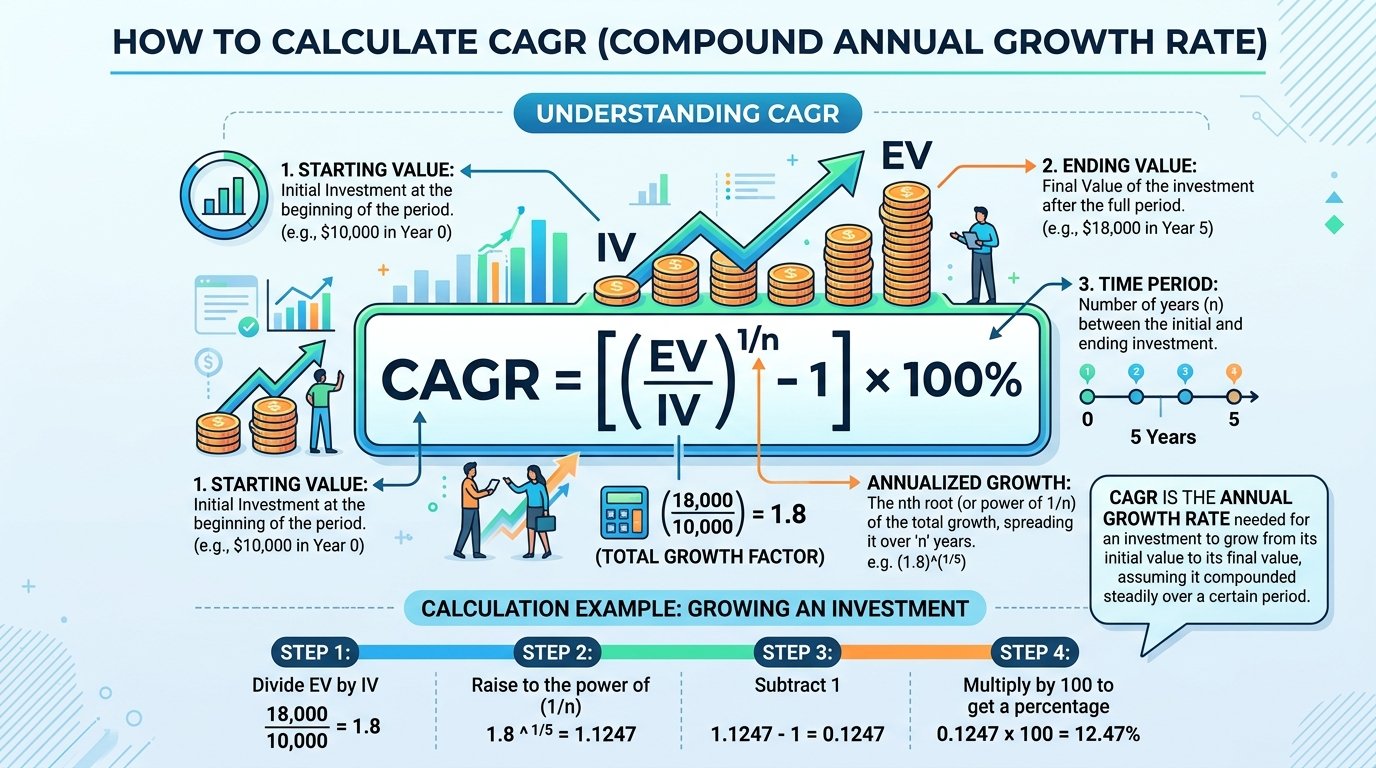
The math behind CAGR compares the final value of an asset against its starting cost over a set number of years. The mathematical CAGR equation is written as:
Where the variables mean:
- Final Value (FV): The ending monetary value of your investment.
- Initial Investment (BV): The starting capital or beginning value.
- n: The total holding period in years.
How to Calculate CAGR Step-by-Step
Let's work through a practical CAGR calculation example to see how the numbers come together.
Suppose you invested ₹100,000 in an equity mutual fund on January 1, 2021. By December 31, 2025 (a span of 5 years), the account balance reaches ₹185,000.
- Divide the final value by the initial investment:
(185,000 / 100,000 = 1.85) - Raise the result to the power of 1 divided by years (1/5 = 0.20):
(1.85^{0.20} approx 1.1309) - Subtract 1 from the result:
(1.1309 - 1 = 0.1309) - Convert to a percentage:
(0.1309 imes 100 = 13.09%)
Your 5-year compound annual growth rate was 13.09%. This means your capital grew as if it earned a steady 13.09% return every year for 5 consecutive years.
CAGR vs Absolute Return vs Simple Average
Investors often confuse absolute return, simple average return, and CAGR. Understanding how they differ keeps you from misinterpreting fund performance stats.
| Metric | What It Measures | Factors in Time? | Best Used For |
|---|---|---|---|
| Absolute Return | Total percentage growth over the whole period | No | Short-term investments (< 1 year) |
| Simple Average Return | Arithmetic mean of annual percentage gains | Partially | Quick rough estimations |
| CAGR | Compounded annual growth rate over time | Yes | Multi-year portfolio comparisons (> 1 year) |
If an investment doubles from ₹50,000 to ₹100,000 over 10 years, the absolute return is 100%. Dividing 100% by 10 gives a simple average of 10% per year. But using our annual growth rate calculator logic, the true investment CAGR is actually 7.18% because of compounding.
Practical Applications of CAGR in Personal Finance
CAGR applies to several financial scenarios beyond stock portfolios:
1. Comparing Different Asset Classes
Imagine you hold gold, stocks, and real estate over a 7-year period. Gold grew by 60% total, real estate by 85%, and stocks by 120%. Converting these figures into CAGR lets you compare annual efficiency directly against fixed deposits or savings accounts.
2. Evaluating Corporate Financial Health
Business analysts evaluate a company's revenue and profit CAGR over 3-year or 5-year periods. A firm with a 15% revenue CAGR consistently expands market share compared to competitors growing at 4%.
3. Setting Future Wealth Goals
If you aim to accumulate ₹1 crore for retirement in 15 years and currently have ₹25 lakh invested, you can use our Investment Calculator or Compound Interest Calculator to determine the exact annual CAGR target needed to hit your goal.
Limitations of CAGR You Should Know
While CAGR is a dependable metrics tool, it has three distinct limitations:
- Ignores Intermediary Volatility: CAGR assumes smooth growth. It hides market crashes or wild spikes occurring during middle years.
- Single Cash Flow Limitation: Standard CAGR percentage formulas work for one lump sum deposit. If you make ongoing contributions, check out our SIP vs Lumpsum Guide to understand XIRR calculations.
- Past Performance Disclaimer: Historical CAGR shows what happened previously; it does not guarantee future market returns.
Try Our Free Online Financial Calculators
Want to calculate your investment growth rate instantly? Use our free interactive tools:
- Investment CAGR & Growth Calculator
- Compound Interest Calculator
- Percentage Calculator
- All Financial Calculators
📚 External Scientific References & Authoritative Sources
- Investopedia Financial Library — Compounding Growth, Ratio Calculations & Financial Formulas.
- U.S. Securities and Exchange Commission (SEC) — Investor Education & Compound Interest Calculations.
- Reserve Bank of India (RBI) — Banking Regulations, Amortization Standards & Lending Guidelines.
Frequently Asked Questions
CAGR stands for Compound Annual Growth Rate. It represents the mean annual growth rate of an investment over a specified time period longer than one year, assuming profits compound over time.
Absolute return measures total percentage gain or loss regardless of time. CAGR factors in time and compounding, providing an annualized growth rate that allows direct comparison between investments held for different durations.
Yes, if the final investment value is lower than the initial investment value, the resulting CAGR calculation will be negative, reflecting an annual percentage loss over the holding period.
Standard CAGR assumes a lump sum initial investment and a final value. For recurring cash flows like monthly SIPs, XIRR (Extended Internal Rate of Return) is used instead of basic CAGR.
Historically, broad equity index funds like the Nifty 50 or S&P 500 yield a CAGR between 10% and 14% over a 10-year horizon, making 12% a common benchmark for long-term equity growth.
Key Takeaways
Calculating CAGR provides an accurate, annual benchmark for evaluating long-term investments. Use it to strip away market volatility, evaluate mutual fund consistency, and plan your long-term financial growth targets with confidence.