Inflation Calculator: Calculate the Value of Money Over Time
Inflation quietly chips away at the purchasing power of your money every single year. An inflation calculator helps you answer practical life questions, such as how much ₹1,00,000 today must become in 10 or 20 years to maintain its buying power, or what an amount from decades ago would equal in modern currency.
Inflation Calculator at a Glance
An inflation calculator measures how rising prices change what your money can buy over time. You provide a starting sum, a projected or historical annual inflation rate, and a timeframe in years. In return, the tool calculates two sides of the same coin: the larger amount of cash needed in the future to afford the same lifestyle, and the shrunken purchasing power of your current savings if left in uninvested cash.
Quick Example: If annual inflation averages 6.0% over the next 10 years, an expense costing ₹1,00,000 today will require approximately ₹1,79,085 in 10 years. Meanwhile, a ₹1,00,000 cash note stored under a mattress will only buy what ₹55,839 buys today, reflecting a 44.16% loss in real purchasing power.
- 1. What Is an Inflation Calculator?
- 2. How Does an Inflation Calculator Work?
- 3. Inflation Calculator Formula
- 4. How to Calculate Inflation (CPI vs Money Impact)
- 5. How to Calculate Future Value After Inflation (5, 10, 20, 30 Years)
- 6. How Inflation Affects Purchasing Power
- 7. Inflation Calculator Real-World Examples (Groceries, College, Retirement)
- 8. Inflation Calculator by Year
- 9. Historical Inflation: What Was Money Worth in the Past?
- 10. How Much Will Things Cost in the Future?
- 11. Inflation vs. Interest Rate: Nominal vs Real Return
- 12. How Inflation Affects Investments
- 13. How Inflation Affects Retirement Planning
- 14. Inflation Calculator for Different Countries
- 15. Inflation vs. Cost of Living: What Is the Difference?
- 16. What an Inflation Calculator Can—and Cannot—Tell You
- 17. Common Inflation Calculation Mistakes
- 18. Frequently Asked Questions
- 19. Final Takeaway
1. What Is an Inflation Calculator?
An inflation calculator is an arithmetic tool designed to show how price changes alter the value of money over time. Money does not have a fixed purchasing power. A basket of groceries that cost ₹1,000 ten years ago costs considerably more today, not because the groceries grew bigger, but because each individual currency unit buys slightly less.
The calculator takes four primary inputs: your base currency amount, the starting time, the ending time, and an annual inflation rate (or historical price index data). It then computes the future cost of that initial amount, the total cumulative price rise, and the reduction in purchasing power.
People use inflation calculators for three main reasons:
- Long-term financial planning: Estimating future costs for college education, weddings, house purchases, or healthcare.
- Historical comparisons: Finding out what grandparents' salaries or past property prices would equal in today's currency.
- Retirement security: Making sure your future pension or retirement corpus accounts for compound price increases over twenty or thirty years.
2. How Does an Inflation Calculator Work?
The mechanism behind an inflation calculator is straightforward:
Starting Amount → Annual Inflation Rate → Time Period → Inflation-Adjusted Future Value
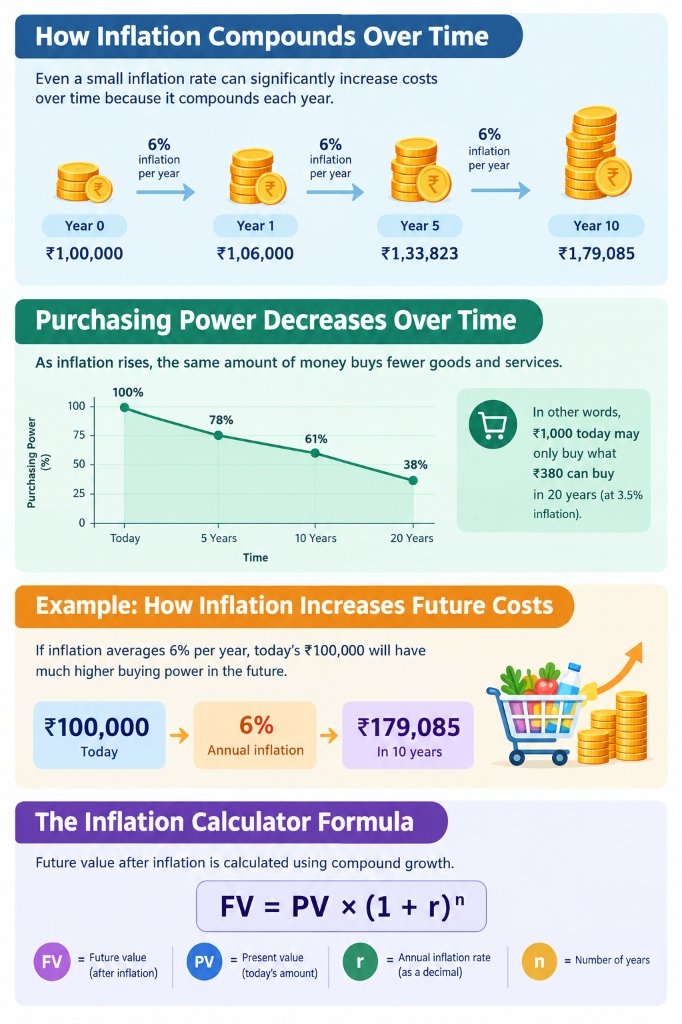
The key reason inflation has such a heavy impact over long horizons is compounding. Inflation does not add a flat percentage of your original money every year. Instead, price increases in year two apply to the already-inflated prices of year one.
Consider this step-by-step example with a starting amount of ₹1,00,000 and an annual inflation rate of 6%:
- Year 1: Price increases by 6% on ₹1,00,000 = ₹1,06,000.
- Year 2: Price increases by 6% on ₹1,06,000 = ₹1,12,360 (an extra ₹6,360, not just ₹6,000).
- Year 3: Price increases by 6% on ₹1,12,360 = ₹1,19,102.
- Year 10: The compounding effect drives the required sum up to ₹1,79,085.
Because prices compound, inflation acts like compound interest working in reverse against your cash savings.
3. Inflation Calculator Formula
The mathematics powering an inflation calculator relies on the classic compound growth formula.
Here is what each variable represents:
- FV (Future Value): The estimated future cost required to buy the exact same goods or services.
- PV (Present Value): The starting amount of money today.
- r (Annual Inflation Rate): The expected or historical yearly inflation rate expressed as a decimal (for example, 6% becomes 0.06).
- n (Number of Years): The duration of the time horizon.
Let us work through an exact calculation:
r = 6% = 0.06
n = 10 years
FV = 100,000 × (1 + 0.06)10
FV = 100,000 × (1.06)10
FV = 100,000 × 1.790848 = ₹1,79,085
If you want to know what ₹1,00,000 in ten years will actually feel like in terms of today's purchasing power, you divide by the compound factor:
₹1,00,000 / (1.06)10 = ₹1,00,000 / 1.790848 = ₹55,839.
4. How to Calculate Inflation (CPI vs Money Impact)
Many financial articles confuse two distinct concepts: calculating the rate of inflation and calculating the effect of inflation on cash. It helps to separate them clearly.
A. Calculating the Inflation Rate from the Consumer Price Index (CPI)
Statistical agencies like the Ministry of Statistics and Programme Implementation (MoSPI) in India or the Bureau of Labor Statistics (BLS) in the United States track a representative basket of hundreds of goods and services. They express the total cost of this basket as an index number (CPI).
Example: Suppose the national CPI was 180 last year and stands at 190.8 this year.
Inflation Rate = [ (190.8 - 180) / 180 ] × 100 = (10.8 / 180) × 100 = 6.0%.
B. Calculating the Effect of Inflation on Money
Once you know the inflation rate, you apply the Future Value formula shown above to determine how that rate alters family budgets, savings targets, and future expenses.
5. How to Calculate Future Value After Inflation
How much will an expense of ₹1,00,000 become after 5, 10, 20, or 30 years? The table below compares the results under different annual inflation rates:
| Time Horizon | At 4% Annual Inflation | At 6% Annual Inflation | At 8% Annual Inflation |
|---|---|---|---|
| 5 Years | ₹1,21,665 | ₹1,33,823 | ₹1,46,933 |
| 10 Years | ₹1,48,024 | ₹1,79,085 | ₹2,15,892 |
| 15 Years | ₹1,80,094 | ₹2,39,656 | ₹3,17,217 |
| 20 Years | ₹2,19,112 | ₹3,20,714 | ₹4,66,096 |
| 25 Years | ₹2,66,584 | ₹4,29,187 | ₹6,84,848 |
| 30 Years | ₹3,24,340 | ₹5,74,349 | ₹10,06,266 |
Notice what happens over 30 years at 6% inflation: the cost increases by nearly 5.75 times. At 8% inflation, it increases by over 10 times. This demonstrates why ignoring inflation in long-term goals creates severe budget shortfalls.
6. How Inflation Affects Purchasing Power
Purchasing power is the amount of goods or services that one unit of money can buy. When prices rise, purchasing power declines.
The relationship is simple:
Inflation Rises ↑ → Purchasing Power of Cash Falls ↓
If a standard movie ticket, snack, and drink cost ₹500 today, and general consumer inflation averages 6% per year:
- In 5 years, that same cinema outing will cost roughly ₹669.
- In 10 years, it will cost roughly ₹895.
- In 20 years, it will cost roughly ₹1,604.
Your ₹500 bill has not physically shrunk, nor has the number printed on it changed. What changed is how much the cashier gives you in exchange for it.
7. Inflation Calculator Real-World Examples
To see how this affects regular life, let us examine three realistic household budgeting scenarios.
Example 1: Monthly Grocery Expenses
- Current Monthly Spend: ₹10,000
- Assumed Food Inflation: 5.0% annually
- Timeframe: 10 years
- Calculation: ₹10,000 × (1.05)10 = ₹16,289 per month
In ten years, your family will need an extra ₹6,289 each month just to buy the exact same carton of milk, vegetables, grains, and household supplies.
Example 2: Children's Higher Education
- Current College Degree Cost: ₹5,00,000
- Education Inflation Rate: 7.0% annually (education costs frequently outpace headline CPI)
- Time Until Enrollment: 15 years
- Calculation: ₹5,00,000 × (1.07)15 = ₹13,79,516
A parent who saves only the current ₹5 lakh cost will find themselves short by more than ₹8.79 lakh when their child enters university.
Example 3: Retirement Living Expenses
- Current Annual Household Expenses: ₹6,00,000 (₹50,000/month)
- Assumed General Inflation: 6.0% annually
- Years Until Retirement: 20 years
- Calculation: ₹6,00,000 × (1.06)20 = ₹19,24,281 per year (₹1,60,357/month)
To maintain the exact same standard of living in retirement, you will need more than three times your current annual cash flow.
8. Inflation Calculator by Year
When people search for an inflation calculator by year, they want to compare the buying power between two specific calendar years.
For instance, how does $1,000 in the year 2000 compare to today, or what was ₹1,00,000 worth in 2010?
To perform a multi-year historical comparison accurately:
- Identify the base year index value from official government records.
- Identify the target year index value.
- Multiply your original sum by the ratio of (Target Year Index / Base Year Index).
Unlike forward projections that rely on assumed rates, historical year-by-year comparisons use actual recorded price changes.
9. Historical Inflation: What Was Money Worth in the Past?
The table below shows how ₹1,00,000 from past decades translates into today's purchasing power, based on historical Indian Consumer Price Index data compiled from the Reserve Bank of India and Ministry of Statistics:
| Historical Year | Original Amount | Approximate Modern Equivalent (2026) | What It Shows |
|---|---|---|---|
| Year 2000 | ₹1,00,000 | ₹4,65,000 – ₹4,85,000 | Prices have increased nearly 4.7-fold over 26 years (~6.2% average CPI). |
| Year 2010 | ₹1,00,000 | ₹2,55,000 – ₹2,70,000 | Prices have more than doubled over 16 years (~6.3% average CPI). |
| Year 2020 | ₹1,00,000 | ₹1,38,000 – ₹1,42,000 | A 38% to 42% cumulative rise over the post-2020 economic period (~5.7% average). |
In the United States, according to the Bureau of Labor Statistics (BLS CPI-U), $1,000 in January 2000 has the same buying power as roughly $1,850 in 2026, reflecting an average long-term inflation rate of about 2.4% per year over that quarter-century.
10. How Much Will Things Cost in the Future?
Not all goods inflate at the headline CPI rate. Different sectors of the economy experience unique supply, labor, and technology pressures:
- Healthcare & Medical Care: Medical inflation routinely runs at 8% to 12% annually in many developing economies due to expensive diagnostic equipment, imported treatments, and private hospital room charges.
- Higher Education: Tuition fees often rise at 7% to 9% per year, outpacing average wage growth.
- Housing & Real Estate: Urban property prices and rents tend to track or exceed local nominal wage growth in growing metropolitan areas.
- Food & Groceries: Food prices can fluctuate sharply due to weather, fuel prices, and supply chain shocks, averaging 5% to 7% over extended cycles.
- Consumer Electronics: Interestingly, consumer tech (laptops, televisions, mobile phones) often exhibits negative inflation (deflation) in terms of processing power per dollar, as manufacturing scale and semiconductor advances reduce production costs.
11. Inflation vs. Interest Rate: Nominal vs Real Return
Interest is the reward you earn for lending or saving money. Inflation is the rate at which goods get more expensive. When you evaluate your savings account or fixed deposit, you must look at your real rate of return.
Many people use a quick rule of thumb:
Approximate Real Return ≈ Nominal Interest Rate - Inflation Rate
Consider what happens in practice:
- You deposit ₹1,00,000 in a fixed bank deposit paying 7.0% interest per year.
- Annual inflation averages 6.0% over that same year.
- At the end of the year, your bank balance shows ₹1,07,000.
- However, goods that cost ₹1,00,000 last year now cost ₹1,06,000.
- Your exact real purchasing power gain is: (1.07 / 1.06) - 1 = 0.94% (less than 1%).
If your savings account pays 3.5% while inflation is 6.0%, your real return is negative (-2.36%). Even though your account balance grows on paper, you can buy fewer groceries at the end of the year than you could at the start.
12. How Inflation Affects Investments
Because cash loses value over time, holding excessive cash in standard checking accounts guarantees a loss of purchasing power. Successful investing requires earning returns that consistently beat inflation after accounting for taxes.
Here is how different asset classes generally interact with inflation:
- Equities (Stocks & Index Mutual Funds): Historically, diversified equities have provided returns well above inflation over 10-to-20-year periods, because businesses can adjust product prices as input costs rise. See our CAGR Calculator guide to evaluate multi-year investment growth.
- Fixed Income (Bonds & FDs): Fixed-rate instruments suffer when unexpected inflation surges, as their coupon payments remain fixed while consumer prices climb.
- Real Estate: Rental yields and property values often adjust upwards with inflation, though liquidity is low and transaction costs are high.
- Gold & Commodities: Precious metals have historically acted as a store of value across multi-decade cycles, though they produce no cash flow or dividends.
To compare how consistent monthly investing combats inflation over time, you can also explore our SIP vs Lumpsum investing breakdown.
13. How Inflation Affects Retirement Planning
Retirement planning is where inflation is most dangerous. In your working years, annual salary increments often help you keep up with rising living expenses. In retirement, your salary stops, but price increases continue for twenty, thirty, or forty years.
Consider a retiree who steps away from work at age 60 needing ₹50,000 per month (₹6,00,000 annually):
- At age 60: Annual need is ₹6,00,000.
- At age 70 (10 years later at 6% inflation): Annual need becomes ₹10,74,509 (₹89,542/month).
- At age 80 (20 years later at 6% inflation): Annual need becomes ₹19,24,281 (₹1,60,357/month).
If that retiree built a corpus assuming their expenses would stay flat at ₹6 lakh each year, their savings will run out years ahead of schedule. For a detailed formula on how to calculate your inflation-adjusted nest egg, read our in-depth guide on calculating your retirement corpus.
14. Inflation Calculator for Different Countries
The mathematics behind inflation calculations applies globally, but the input rates differ depending on the local economy and currency:
- India (INR): The headline inflation benchmark is the Consumer Price Index (Combined) published monthly by the National Statistical Office (NSO / MoSPI). The Reserve Bank of India (RBI) operates with a target inflation band of 4% with a 2% tolerance band (2% to 6%).
- United States (USD): The primary measure is the Consumer Price Index for All Urban Consumers (CPI-U), published monthly by the Bureau of Labor Statistics (BLS). The Federal Reserve targets an average inflation rate of 2.0% over time.
- United Kingdom (GBP): The Office for National Statistics (ONS) tracks the Consumer Prices Index including owner occupiers' housing costs (CPIH) and the standard CPI, targeting a 2.0% annual rate.
- Euro Area (EUR): Eurostat tracks the Harmonised Index of Consumer Prices (HICP) across eurozone member nations, with a medium-term target of 2.0%.
- Canada (CAD) & Australia (AUD): Tracked respectively by Statistics Canada and the Australian Bureau of Statistics (ABS), each using weighted consumer baskets tailored to domestic consumption habits.
15. Inflation vs. Cost of Living: What Is the Difference?
While people often use these terms interchangeably, economists treat them differently:
- Inflation measures the percentage change in the price of a fixed, standardized basket of goods and services over time. It assumes the basket remains constant.
- Cost of Living measures how much money you need to maintain a specific standard of living, taking into account housing choices, lifestyle upgrades, taxes, healthcare, and location.
For instance, moving from a tier-2 town to a major metropolitan city immediately increases your cost of living by 40% or 50%, even if national inflation is only running at 5%. Similarly, as your family grows or you buy a larger home, your personal living expenses increase independently of official inflation statistics.
16. What an Inflation Calculator Can—and Cannot—Tell You
An inflation calculator is an estimation model. Knowing its boundaries helps you plan with realistic expectations:
What the Calculator CAN Do:
- Translate future costs into present-day equivalents.
- Demonstrate how compound price increases erode uninvested cash.
- Calculate exact mathematical outcomes for any assumed rate and timeframe.
What the Calculator CANNOT Do:
- It cannot predict actual future inflation rates, which fluctuate due to oil prices, geopolitics, and central bank policy.
- It cannot match your unique personal spending pattern, since your personal basket of expenses rarely matches the national CPI weights.
- It cannot account for local real estate price booms or sudden localized tuition hikes.
17. Common Inflation Calculation Mistakes
When people calculate inflation numbers on their own, they often make one of these six errors:
- Using Simple Interest Instead of Compounding: Multiplying 6% by 10 years to get 60% ignores compounding. The actual 10-year cumulative inflation at 6% is 79.08%, which is almost 20 percentage points higher.
- Confusing the Annual Inflation Rate with Cumulative Price Rise: An annual inflation rate of 7% sounds modest, but over 15 years, it produces a cumulative price surge of 175.9%.
- Assuming One Flat Rate Forever: Inflation varies from year to year. A realistic long-term financial plan should stress-test with both moderate (5%) and elevated (7% or 8%) inflation assumptions.
- Confusing Nominal Account Balances with Real Buying Power: Seeing ₹10 lakh in your bank account does not mean your wealth grew if consumer prices doubled over the same period.
- Using One Country's Inflation Rate for Another: Projecting future rupee expenses using US Federal Reserve 2% targets will severely underestimate future costs, just as using Indian inflation rates for dollar-denominated expenses will overestimate them.
- Ignoring Sector-Specific Inflation: Using general headline CPI (5%-6%) to plan for medical emergencies or university tuition often results in substantial funding gaps.
18. Frequently Asked Questions
Here are straightforward answers to common questions about inflation calculations and currency values:
An inflation calculator is a mathematical tool that estimates how price rises change the purchasing power of money over time. It shows what an amount of money from the past is worth today, or how much you will need in the future to buy the same basket of goods.
The calculator uses compound interest mathematics. It takes your starting principal, an assumed annual inflation rate, and the number of years. It compounds the price increases annually to calculate the higher future cost and the reduced purchasing power of your initial cash.
To calculate the inflation rate between two dates, subtract the earlier Consumer Price Index (CPI) number from the current CPI number, divide by the earlier CPI number, and multiply by 100. To find the future price of an item, multiply the present price by (1 + inflation rate) raised to the number of years.
The future value formula after inflation is FV = PV × (1 + r)n, where FV is the future cost, PV is present value, r is the annual inflation rate as a decimal, and n is the number of years.
At an average annual inflation rate of 6%, an item costing ₹1,00,000 today will cost about ₹1,79,085 in 10 years. Conversely, ₹1,00,000 in uninvested cash will only hold the purchasing power equivalent to about ₹55,839 in today's money.
Purchasing power is calculated by dividing your current money by (1 + inflation rate)n. If a basket of groceries costs ₹1,000 today and inflation averages 5% for 10 years, that basket will cost ₹1,629, meaning each rupee buys roughly 38.6% less.
Inflation represents the rate at which general prices increase, eroding the buying power of cash. Interest is the money earned on an investment or paid on a loan. Your real return equals your interest rate minus the inflation rate.
Yes. By looking at official Consumer Price Index (CPI) figures published by government statistical agencies (such as MoSPI in India or the BLS in the United States), you can calculate the exact percentage change in prices between any two historical years.
No. An inflation calculator projects mathematical outcomes based on the rate you enter. It cannot forecast unpredictable economic events, changes in energy costs, currency swings, or future monetary policy decisions by central banks.
Yes. Inflation compounds year after year. A 6% inflation rate in year two applies to the already-higher prices from year one. This compounding effect causes prices to double in approximately 12 years at a 6% annual rate.
For personal budgeting, use the Consumer Price Index (CPI), which tracks prices paid by households for everyday goods and services. For business wholesale purchases, economists refer to the Wholesale Price Index (WPI) or Producer Price Index (PPI).
Yes, the math formula FV = PV × (1 + r)n works for any currency. However, you must use the appropriate historical inflation rate and price index for that specific country, as inflation rates vary widely across different economies.
19. Final Takeaway
Inflation gradually changes what your money can buy. An inflation calculator helps translate that abstract change into concrete numbers, allowing you to estimate future living expenses, compare historical values accurately, and build realistic savings and retirement plans.
- Reserve Bank of India (RBI). (2025). Monetary Policy Report & CPI Inflation Projections. Available at: rbi.org.in
- Ministry of Statistics and Programme Implementation (MoSPI). (2026). Consumer Price Index (CPI) Rural/Urban/Combined Monthly Releases. Government of India. Available at: mospi.gov.in
- U.S. Bureau of Labor Statistics (BLS). (2026). Consumer Price Index Databases & Historical Inflation Tables (CPI-U). U.S. Department of Labor. Available at: bls.gov/cpi
- Office for National Statistics (ONS). (2025). Consumer Price Inflation, UK: Methodology and User Guide. Available at: ons.gov.uk
- European Central Bank (ECB). (2025). Harmonised Index of Consumer Prices (HICP) and Price Stability Objective. Available at: ecb.europa.eu
- International Monetary Fund (IMF). (2025). World Economic Outlook: Navigating Global Inflation and Interest Rate Normalization. Available at: imf.org
- World Bank Group. (2024). Global Economic Prospects: Inflation Pressures and Monetary Policy Trajectories. Available at: worldbank.org
- Organisation for Economic Co-operation and Development (OECD). (2025). Consumer Price Indices (CPI) Data Portal and Comparative Statistics. Available at: data.oecd.org
- Fisher, I. (1930). The Theory of Interest: As Determined by Impatience to Spend Income and Opportunity to Invest It. Macmillan. (Foundational text on nominal versus real interest rates).
- Board of Governors of the Federal Reserve System. (2025). Economic Education: What Is Inflation and How Does the Federal Reserve Measure It? Available at: federalreserve.gov