⚡ The Quick Answer
Cryptocurrency is digital money that uses cryptography and a decentralized computer network to record, verify, and secure transactions without relying on a central bank or government. Every payment is grouped with others into digital blocks and permanently linked on a public ledger called a blockchain. Users manage their coins through a cryptocurrency wallet, which holds private mathematical keys used to sign transactions and transfer value worldwide.
If you have ever tried asking someone how cryptocurrency works, you may have received a confusing lecture filled with technical jargon like "hashes," "mempools," and "distributed consensus." It sounds intimidating at first. But beneath the vocabulary, cryptocurrency is simply an accounting ledger managed by thousands of independent computers instead of one centralized bank.
When you make a standard digital bank transfer, you trust your bank to deduct money from your account and add it to someone else's. Cryptocurrency accomplishes that exact same outcome. The key difference is that no single company, bank, or government controls the records.
- 1. How Does Cryptocurrency Work? (The 6 Core Steps)
- 2. What Is Cryptocurrency?
- 3. What Is Blockchain and How Does It Work?
- 4. How Do Crypto Transactions Work?
- 5. How Do Cryptocurrency Wallets Work?
- 6. How Is Cryptocurrency Verified? (Nodes & Consensus)
- 7. How Does Crypto Mining Work?
- 8. How Does Cryptocurrency Get Its Value?
- 9. How Do Cryptocurrency Exchanges Work?
- 10. How Does Crypto Conversion Work?
- 11. What Are Cryptocurrency Fees?
- 12. Cryptocurrency vs Traditional Currency
- 13. Advantages and Important Risks
- 14. A Simple Step-by-Step Example (Alice Sends Bob 0.01 BTC)
- 15. Frequently Asked Questions
- 16. Key Takeaways
How Does Cryptocurrency Work?
To understand how cryptocurrency works in real life, imagine a simple scenario: Alice wants to send 0.01 Bitcoin (BTC) to Bob to pay for freelance graphic design work. Here is what happens behind the scenes from the moment Alice hits "Send" to the moment Bob receives the funds.
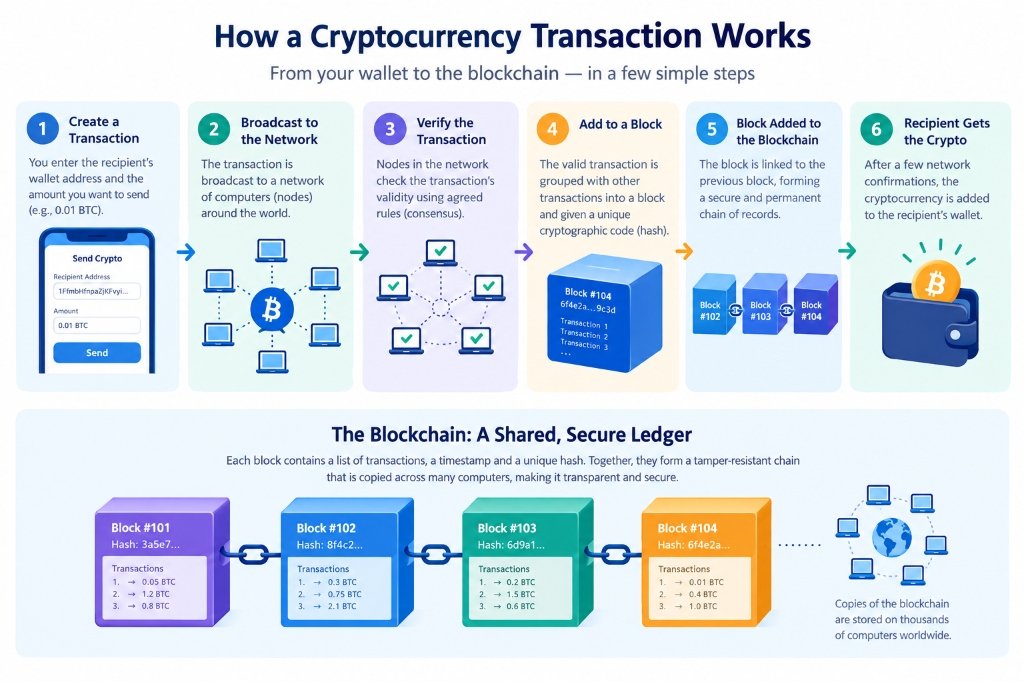
1. A user initiates a transaction
Alice opens her cryptocurrency wallet app on her smartphone or computer. She pastes Bob's public wallet address (a long string of letters and numbers like bc1qxy2kgdygjrsqtzq2n0yrf2493p83kkfjhx0wlh) and enters the amount: 0.01 BTC.
When Alice presses confirm, her wallet software uses her secret private key to create a digital mathematical signature. This signature proves to the world that Alice owns the 0.01 BTC without ever exposing her secret password to anyone.
2. The transaction is broadcast to the network
Alice's wallet transmits this signed message to neighboring computers on the cryptocurrency network, known as nodes. These nodes pass the message along to other nodes in a matter of seconds. At this stage, the transaction enters an unconfirmed holding area called the mempool (memory pool).
3. The network verifies the transaction
Every node that receives Alice's transaction performs an automated mathematical check:
- Does the digital signature match Alice's public address?
- Does Alice actually have at least 0.01 BTC available to spend?
- Has this specific coin already been spent elsewhere (preventing "double-spending")?
If Alice does not have enough balance, or if the digital signature is forged, the nodes reject the transaction immediately.
4. The transaction enters a block
Individual transactions waiting in the mempool are gathered together by network verifiers (called miners in Bitcoin or validators in Ethereum). They bundle hundreds or thousands of verified payments into a single package called a block.
5. The block becomes part of the blockchain
Before a candidate block can be added to the official history, the verifier must satisfy the network's consensus rules (such as solving a cryptographic puzzle in Proof of Work or staking collateral in Proof of Stake).
Once satisfied, the block is permanently attached to the previous block using a unique mathematical fingerprint called a hash. This forms an unbroken, chronological chain of records: the blockchain.
6. The recipient receives the cryptocurrency
Once the block is written to the ledger, all nodes update their local copies of the database. Bob's wallet monitors the network, recognizes the 0.01 BTC assigned to his public address, and displays the updated balance. Bob can now spend those funds.
What Is Cryptocurrency?
At its simplest, a cryptocurrency is a medium of exchange that exists solely in digital form. The word comes from cryptography (the mathematical science of encrypting data and creating unforgeable digital signatures) and currency (money used for trade).
Unlike a paper dollar bill or a silver coin, cryptocurrency has no physical token. You cannot hold a Bitcoin in your pocket. Instead, what you own is the exclusive mathematical ability to reassign a specific amount of digital value on a shared ledger.
What makes cryptocurrency different from traditional money?
Traditional currencies like the US Dollar (USD), Euro (EUR), or Indian Rupee (INR) are known as fiat currencies. They are declared legal tender by central governments, printed by central banks, and tracked within private banking software.
| Feature | Cryptocurrency | Traditional Currency (Fiat) |
|---|---|---|
| Form | 100% digital tokens stored on a shared network | Physical banknotes and coins plus centralized bank databases |
| Central Authority | Decentralized network (or code-defined foundation) | Central bank and sovereign government |
| Ledger System | Public distributed blockchain visible to anyone | Private proprietary databases controlled by individual banks |
| Verification | Independent nodes running mathematical consensus rules | Payment processors, clearinghouses, and bank clerks |
| Supply Policy | Fixed or algorithmically scheduled (e.g., 21M Bitcoin limit) | Flexible; central banks print or withdraw money as economic policy dictates |
| Permission Needed | Permissionless; anyone with internet access can create an address | Permissioned; requires identification, approval, and a bank account |
What Is Blockchain and How Does It Work?
You often hear the terms "crypto" and "blockchain" used as if they are the exact same thing. They are related, but they are not identical.
Cryptocurrency is the digital money; blockchain is the digital notebook that records who owns that money.
What is a blockchain?
A blockchain is a shared, tamper-resistant digital ledger. Instead of keeping all financial accounts on a single server owned by a bank like JPMorgan or State Bank of India, identical copies of the blockchain file are saved across tens of thousands of independent computers around the globe.
What is inside a block?
Each block functions like a page in an accounting ledger. A typical block contains four main elements:
- Transaction Data: The list of sender addresses, recipient addresses, and amounts transferred.
- Timestamp: The exact date and time the block was created.
- Current Hash: A unique 64-character alphanumeric fingerprint representing the exact contents of that block.
- Previous Hash: The fingerprint of the block that came directly before it.
How are blocks linked together?
The linking mechanism is what gives blockchain its name. In computer science, a cryptographic hash function (such as SHA-256) takes any input data and converts it into a fixed string of characters. Even changing one single comma or digit in a transaction creates a completely unrecognizable new hash.
Because Block 2 includes the exact hash of Block 1, and Block 3 includes the hash of Block 2, every block is mathematically locked to the one before it.
Why is blockchain so difficult to alter?
Suppose a dishonest participant tries to alter an old transaction from two years ago to give themselves extra coins.
As soon as they edit that old block, its hash changes completely. Because the next block relied on the original hash, the link breaks. Every subsequent block becomes invalid.
To make the rest of the network accept their forged chain, the attacker would have to recalculate the mathematical proofs for that block and every block built on top of it faster than all other computers combined. On large networks like Bitcoin or Ethereum, doing this is practically impossible and economically ruinous.
Is blockchain the same as cryptocurrency?
No. Blockchain is the foundational database technology. While cryptocurrencies like Bitcoin and Litecoin use blockchain to track payments, blockchain technology is also used for supply chain tracking, digital medical records, identity verification, and legal property registries.
How Do Crypto Transactions Work?
To grasp how payments move securely across the internet without a trusted middleman, you need to understand asymmetric public-key cryptography.
What is a crypto wallet?
A common misconception is that a cryptocurrency wallet holds digital coins the way a leather wallet holds banknotes.
Your wallet does not contain any coins. The coins live permanently on the blockchain. Your wallet simply stores the cryptographic keys that give you the legal and mathematical authority to move those coins.
What is a wallet address?
A wallet address is your public destination on the network. You can share it freely with anyone who wants to pay you, similar to sharing an email address or bank account number. An address is derived mathematically from your public key.
What is a private key?
Your private key is the secret password that authorizes withdrawals. It is a 256-bit number that looks like a long string of random hexadecimal characters.
Whoever possesses the private key controls the cryptocurrency associated with that address. If you share your private key with someone, they can take your funds permanently.
What is a digital signature?
When you make a transaction, your wallet combines the payment details with your private key to produce a unique mathematical output: a digital signature.
Other computers on the network can run a mathematical formula using your public address to confirm that the signature could only have been generated by someone holding the corresponding private key. They can prove you approved the transfer without ever seeing your private key.
How Do Cryptocurrency Wallets Work?
Cryptocurrency wallets come in several formats depending on how much convenience and security you require.
Hot wallets vs cold wallets
- Hot Wallets: Software applications installed on phones, laptops, or browser extensions (like MetaMask or Trust Wallet). They stay connected to the internet. They make daily payments and trading fast and easy, but they carry greater vulnerability to malware, fake browser extensions, and phishing scams.
- Cold Wallets: Physical hardware devices (such as Ledger or Trezor) or paper backups that keep your private keys completely offline. To make a transaction, you connect the hardware device to your computer, sign the transaction locally inside the chip, and transmit only the approved signature. Cold storage offers the highest level of personal security against internet hackers.
Custodial vs non-custodial wallets
- Custodial Wallets: When you buy cryptocurrency on a centralized exchange like Coinbase, Binance, or CoinDCX, the exchange holds the private keys on your behalf. You log in with an email and password. While convenient for beginners, you rely on the exchange to safeguard your funds and remain solvent.
- Non-Custodial (Self-Custody) Wallets: You control the private keys and the 12-to-24 word recovery phrase yourself. No bank or company can freeze your account, but if you lose your recovery phrase, your funds are gone forever.
| Wallet Term | What It Means | Analogy |
|---|---|---|
| Public Address | The public destination where funds are sent | Your bank account number or email inbox |
| Private Key | The secret cryptographic key used to authorize spending | Your digital pen and banking PIN combined |
| Seed Phrase | A list of 12 or 24 simple words that can restore all your keys | A master backup key to your safe deposit box |
| Wallet Software | An interface to check balances and assemble transactions | An online banking mobile app |
How Is Cryptocurrency Verified?
Because there is no central headquarters or chief executive officer managing a public blockchain, the network must have a reliable method to agree on which transactions are valid. This agreement process is called consensus.
What are crypto nodes?
A node is any computer running the blockchain's open-source software. Full nodes store a complete copy of the ledger from its very first block to the latest one. They independently verify every single transaction and reject any block that breaks the protocol's mathematical rules.
Proof of Work (PoW)
Used by Bitcoin, Dogecoin, and Litecoin, Proof of Work requires verifiers (miners) to expend physical energy and computing hardware. Miners compete to solve an arbitrary cryptographic puzzle.
The first miner to find a valid solution earns the right to write the next block and claims a block reward. The massive energy cost makes it economically irrational for anyone to attempt forging transactions.
Proof of Stake (PoS)
Used by Ethereum, Solana, and Cardano, Proof of Stake replaces energy-hungry mining rigs with financial collateral. Instead of buying electricity, participants lock up (or "stake") their own cryptocurrency into a smart contract to become validators.
The network algorithmically chooses validators to propose and attest to new blocks based on their staked amount. If a validator attempts to approve fraudulent records or attacks the network, the protocol automatically confiscates a portion of their staked coins (a penalty known as slashing).
How Does Crypto Mining Work?
Mining serves two distinct purposes: it secures the network by confirming transactions, and it introduces new coins into circulation in a predictable, controlled manner.
How Bitcoin mining works in practice
- Grouping Transactions: Mining computers assemble several thousand unconfirmed transactions from the mempool into a candidate block.
- Hashing the Header: The mining computer passes the block's header data through the SHA-256 algorithm.
- Finding the Nonce: The network sets a target difficulty level. The resulting hash must begin with a specific number of zeros. Because hash outputs cannot be predicted, the miner must change a small counter number called a nonce billions of times per second until an acceptable hash is generated.
- Announcing the Solution: Once a miner discovers a valid nonce, they broadcast the block to the network. Other nodes verify the solution in milliseconds and add the block to their ledgers.
Do all cryptocurrencies use mining?
No. In fact, most modern cryptocurrencies developed over the last five years do not use mining at all. Ethereum completed a landmark transition from Proof of Work to Proof of Stake in September 2022, cutting its energy consumption by more than 99.9%.
How Does Cryptocurrency Get Its Value?
Cryptocurrency is not backed by gold in a vault, nor is it supported by the legal decree of a sovereign government. So why does 1 Bitcoin or 1 Ether trade for thousands of dollars?
Like any commodity, currency, or stock, a cryptocurrency's price is determined primarily by market supply and demand:
- Scarcity: Bitcoin has a hardcoded lifetime cap of 21 million coins. No board of directors can vote to create 10 million more. Every four years, a scheduled event called the halving cuts the creation rate of new Bitcoin in half.
- Utility: Some networks have clear computational uses. For example, to execute a transaction, run a financial smart contract, or trade a token on Ethereum, users must pay fees in Ether (ETH). Demand for the network drives demand for the token.
- Adoption & Liquidity: As more payment processors, investment funds, and individuals accept a coin, trading volume increases, making it easier to buy and sell at stable prices.
- Market Sentiment & Speculation: A significant portion of crypto market movements is driven by investor psychology, news cycles, macroeconomic interest rates, and regulatory announcements.
How Do Cryptocurrency Exchanges Work?
Most people do not mine cryptocurrency or set up command-line nodes; they acquire their first coins on a cryptocurrency exchange.
An exchange functions like a stock brokerage. It acts as an intermediary platform where buyers and sellers meet:
- Fiat On-Ramps: Platforms that allow you to deposit traditional currency (like US Dollars via bank transfer, or Indian Rupees via UPI and IMPS) to purchase cryptocurrency.
- Order Books: Digital lists showing the prices at which buyers are willing to purchase (bids) and sellers are willing to part with their coins (asks). When prices match, a trade occurs.
- Price Differences Between Exchanges: Because exchanges operate independently, prices can vary slightly between platforms. Market traders called arbitrageurs buy coins on cheaper exchanges and sell them on higher-priced ones, keeping prices closely aligned worldwide.
How Does Crypto Conversion Work?
Because cryptocurrency prices fluctuate continuously throughout the day, estimating how much crypto you need for a purchase requires calculating its live market exchange rate against your local fiat currency.
Let us look at a few practical conversion scenarios:
1. Converting Bitcoin to US Dollars (BTC to USD)
Suppose Bitcoin is currently trading at an illustrative market rate of $64,000 USD per 1 BTC. If you want to know what 0.05 BTC is worth:
2. Converting Bitcoin to Indian Rupees (BTC to INR)
Suppose Bitcoin trades at an illustrative rate of ₹5,400,000 INR per 1 BTC. To calculate the value of 0.025 BTC:
3. Converting Ethereum to Indian Rupees (ETH to INR)
If Ethereum is priced at ₹280,000 INR per 1 ETH, and you receive an invoice for 0.75 ETH:
4. Crypto-to-crypto conversion
You can also convert one cryptocurrency into another directly. For example, if 1 ETH is priced at $3,200 and 1 BTC is priced at $64,000, then:
🧮 Check Live Crypto Exchange Rates Instantly
Need to calculate live conversions across Bitcoin, Ethereum, Solana, or USDT against USD, INR, EUR, and 30+ fiat currencies? SmartCalc provides real-time pricing powered by independent market data.
Open Free Crypto Converter ➔What Are Cryptocurrency Fees?
When dealing with cryptocurrency, you will encounter different types of fees. Beginners often confuse network fees with exchange fees. Here is how they differ:
| Fee Category | Who Collects It? | Why Do You Pay It? |
|---|---|---|
| Network / Gas Fees | Blockchain miners or validators | Compensates the network for processing data and prevents spam attacks. Fees rise when the network is congested. |
| Trading / Maker-Taker Fees | The centralized exchange platform | Covers the exchange's matching service when you buy or sell coins (typically 0.1% to 0.5% per trade). |
| Withdrawal Fees | The exchange platform | Charged when you move coins from your exchange account to an external private cold wallet. |
| Spread | Brokers and trading desks | The hidden difference between the real market price and the price quoted to you for instant execution. |
Cryptocurrency vs Traditional Currency
Both cryptocurrency and traditional fiat currency function as stores of value and units of account. However, their underlying infrastructure represents two fundamentally different views of monetary management.
| Comparison Point | Cryptocurrency | Fiat Currency |
|---|---|---|
| Physical Cash | No; purely digital entries | Yes; physical banknotes, coins, and checks |
| Issuer | Cryptographic protocol and network consensus | Sovereign central banks (Federal Reserve, RBI, ECB) |
| Inflation Protection | Often built-in supply caps (e.g., Bitcoin) | Subject to currency debasement and central bank policy |
| Transaction Reversal | Impossible once confirmed on chain | Possible through chargebacks, dispute resolution, or bank recall |
| Global Border Friction | Identical whether sending next door or across continents | Requires SWIFT networks, foreign exchange markups, and multi-day delays |
| Consumer Protection | Zero deposit insurance; user holds 100% security responsibility | Government deposit insurance (e.g., FDIC in US, DICGC in India) |
What Are the Advantages and Risks of Cryptocurrency?
Cryptocurrency offers distinct technical benefits, but it also carries serious financial and personal responsibilities. A balanced understanding is essential before participating in the market.
Potential advantages
- 24/7 Global Transfers: Traditional banking rails pause on weekends and national holidays. Cryptocurrencies settle payments 24 hours a day, 365 days a year, without international banking delays.
- Financial Inclusion: Anyone with a smartphone and internet access can download a wallet and receive payments. No credit checks, minimum balance requirements, or banking documentation are needed.
- Ownership and Censorship Resistance: In self-custody wallets, no third party can freeze your account, seize your funds, or block a payment to a lawful recipient.
- Programmable Money: Platforms like Ethereum support smart contracts—self-executing code that automatically carries out agreements when predetermined conditions are met.
Important risks to keep in mind
- High Price Volatility: Crypto markets experience large price swings within single days. Assets can drop 50% to 80% during market downturns.
- Irreversible Mistakes: If you mistype a single character in a recipient address or send funds across an incompatible network, the coins are permanently lost. No customer service team can retrieve them.
- Loss of Private Keys: If you lose your hardware wallet and your backup recovery seed phrase, there is no "Forgot Password" button. Your funds remain locked on the blockchain forever.
- Scams and Phishing: Fraudulent websites, impersonation schemes, and fake customer support groups target newcomers relentlessly.
- Regulatory and Tax Complexity: Tax rules regarding capital gains and reporting requirements vary by country and change frequently.
⚠️ Financial and Educational Disclaimer: This article is provided strictly for educational and informational purposes. It does not constitute financial, investment, legal, or tax advice. Cryptocurrency assets are highly volatile and unregulated in many jurisdictions. Always conduct thorough independent research and never invest money you cannot afford to lose.
A Simple Example of How Cryptocurrency Works
Let us revisit Alice and Bob to walk through the complete journey of a real-world transaction:
- Bob generates an invoice: Bob opens his smartphone wallet and clicks "Receive." The app presents his public address and a QR code requesting 0.01 BTC.
- Alice signs the payment: Alice scans Bob's QR code. Her wallet automatically sets an appropriate network fee (for example, $1.50 worth of satoshis) based on current mempool traffic. Alice confirms the payment using her thumbprint on her phone, which unlocks her private key to sign the transaction.
- The network relays the message: Alice's phone sends the signed data to a nearby Bitcoin node. Within 3 seconds, nodes in Europe, Asia, and North America have received the message and placed it into their memory pools.
- A miner packages the block: Ten minutes later, a mining pool in Iceland solves the Proof of Work puzzle for Block #890,142. Alice's payment is included along with 2,400 other transactions.
- The block is locked into the chain: The miner broadcasts the winning block. Thousands of independent nodes verify the math and write Block #890,142 to their hard drives.
- Bob sees confirmation: Bob's phone chimes. His wallet app shows "1 Confirmation: +0.01 BTC Received." After two more blocks are added on top of it, the payment is virtually impossible to reverse.
Frequently Asked Questions About How Cryptocurrency Works
Cryptocurrency functions like digital money that is tracked across a shared, public computer network rather than inside a single bank. When you send funds, cryptographic software signs the request, independent computers verify your balance, and the transfer is permanently added to a secure ledger called a blockchain.
Bitcoin uses a Proof of Work consensus system. Miners use specialized computing hardware to bundle transactions into blocks and solve mathematical puzzles. The winning miner earns newly minted Bitcoin plus transaction fees, adding the verified block to an immutable public chain.
Blockchain is the database architecture. Each block contains a batch of recent payments and the mathematical fingerprint (hash) of the block that preceded it. Because identical copies of this ledger exist on thousands of computers, any unauthorized attempt to alter past records is rejected immediately by the rest of the network.
Independent nodes use cryptographic math to verify two core criteria: that the sender created a valid digital signature using their secret private key, and that the sender's account has enough unspent coins to complete the payment without spending the same money twice.
Cryptocurrency does not pay a guaranteed salary or standard corporate dividend. Investors profit if they sell an asset for a higher price than they paid to purchase it. Network verifiers also earn rewards by validating transactions (mining or staking). Keep in mind that prices can drop just as quickly, resulting in losses.
Yes. You can sell cryptocurrency for fiat currency (like USD, EUR, or INR) on licensed exchanges or peer-to-peer marketplaces and transfer the cash directly into your personal bank account.
No. Once a transaction is confirmed and written to a block, it is permanent. Unlike credit card payments, there is no central authority to process chargebacks or reverse an accidental transfer.
No. Bitcoin was the first cryptocurrency created in 2009. While it remains the largest by market capitalization, thousands of other digital assets exist—such as Ethereum, Solana, and Cardano—offering different features like smart contracts and faster settlement speeds.
Key Takeaways
- Decentralized Ledger: Cryptocurrency operates on a shared blockchain network rather than relying on a centralized bank.
- Keys, Not Coins: Crypto wallets store cryptographic private and public keys, not physical coins.
- Digital Signatures: Transactions are authorized with private keys and verified mathematically by independent nodes.
- Consensus Rules: Networks use consensus mechanisms like Proof of Work (mining) or Proof of Stake (staking) to validate payments.
- Permanence: Confirmed crypto transactions are irreversible; accuracy and personal custody security are essential.
- Market Pricing: Prices fluctuate based on market supply, utility, liquidity, and broader economic sentiment.
Explore SmartCalc's Financial & Math Tools
Planning an investment, calculating financial ratios, or checking international exchange rates? SmartCalc provides fast, free, browser-based tools with zero tracking:
- Crypto Converter — Calculate live exchange values between Bitcoin, Ethereum, Solana, and 30+ fiat currencies.
- Currency Converter — Convert real-time foreign exchange rates for USD, EUR, INR, GBP, and AED.
- Investment Calculator — Estimate compound growth and future portfolio targets.
- Percentage Calculator — Calculate price swings, profit margins, and percentage changes easily.
- Nakamoto, S. (2008). Bitcoin: A Peer-to-Peer Electronic Cash System. Bitcoin Project Whitepaper. Available at: bitcoin.org/bitcoin.pdf
- Buterin, V. (2014). A Next-Generation Smart Contract and Decentralized Application Platform. Ethereum Whitepaper. Available at: ethereum.org/en/whitepaper
- National Institute of Standards and Technology (NIST). (2018). Blockchain Technology Overview (NISTIR 8202). U.S. Department of Commerce. Available at: csrc.nist.gov (NISTIR 8202)
- Bank for International Settlements (BIS). (2018). Annual Economic Report: Cryptocurrencies: Looking Beyond the Hype. BIS Monetary and Economic Department. Available at: bis.org/publ/arpdf/ar2018e5.htm
- Cambridge Centre for Alternative Finance (CCAF). (2024). Cambridge Bitcoin Electricity Consumption Index (CBECI) & Global Cryptoasset Benchmarking Study. University of Cambridge Judge Business School. Available at: ccaf.io/cbeci
- IEEE Computer Society. (2020). A Survey on Blockchain Consensus Algorithms and Applications. IEEE Access, 8, 41656-41672. Available at: IEEE Xplore Digital Library
- ACM (Association for Computing Machinery). (2019). ACM Transactions on Computer Systems: Distributed Ledgers and Cryptographic Verification Protocol Benchmarks. Available at: ACM Digital Library
- Financial Stability Board (FSB). (2023). High-Level Recommendations for the Regulation, Supervision and Oversight of Crypto-Asset Activities and Markets. Available at: fsb.org Crypto-Asset Policy
- European Central Bank (ECB). (2020). Crypto-Assets: Implications for Financial Stability, Monetary Policy, and Payments. ECB Occasional Paper Series. Available at: ecb.europa.eu
- U.S. Commodity Futures Trading Commission (CFTC). (2024). Customer Advisory: Understand the Risks of Virtual Currency Trading. CFTC Office of Customer Education and Outreach. Available at: cftc.gov Virtual Currency Advisory