An Average Percentage Calculator calculates the single overall mean percentage from multiple percentage values or test scores. It accounts for equal or weighted sample sizes, giving students, teachers, and data analysts an accurate final percentage score across exam subjects, survey results, or business metrics.
Understanding Simple vs Weighted Average Percentage
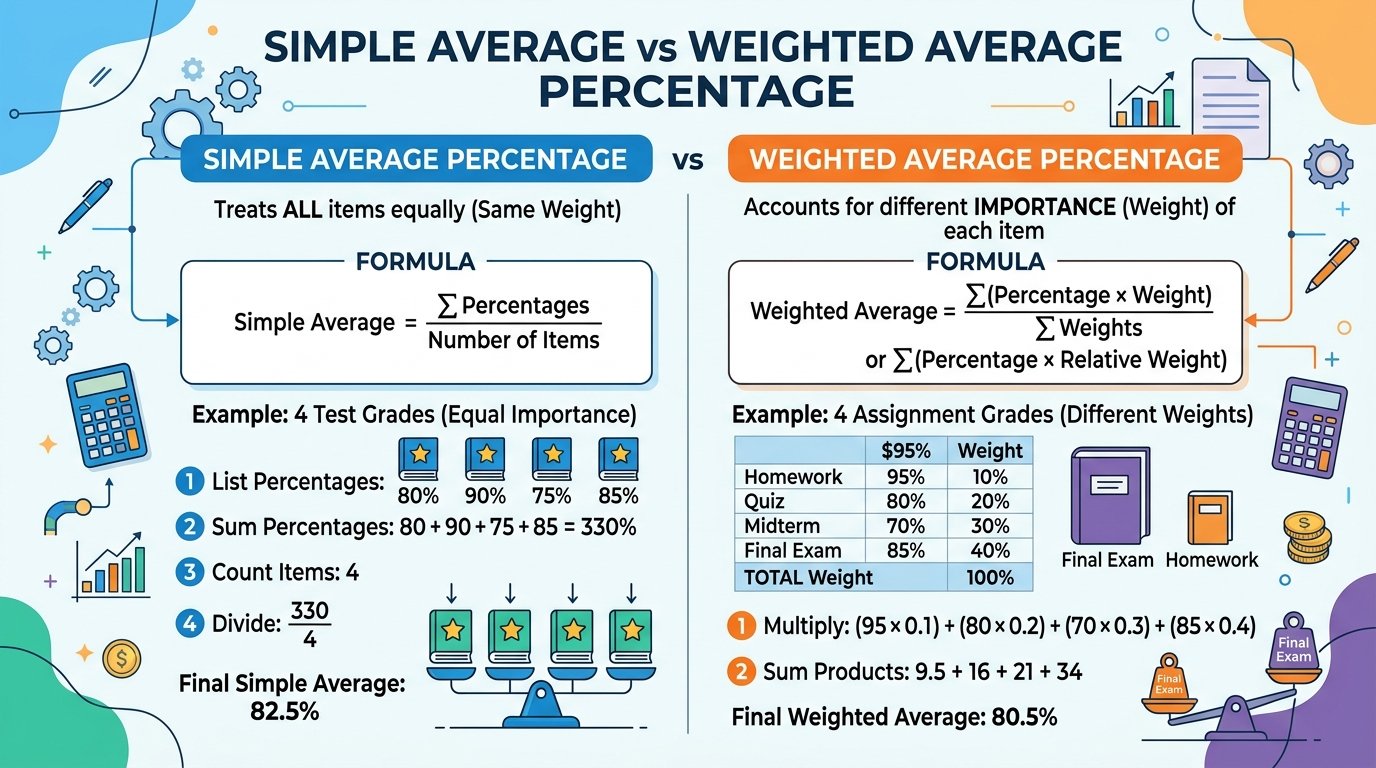
Calculating the average of ordinary numbers (like 10, 20, and 30) is straightforward: you add them together and divide by 3. However, when working with percentage values, taking a simple average can sometimes produce incorrect mathematical results.
If you scored 80% on a short 10-question quiz and 90% on a massive 100-question final exam, your overall grade is not 85%. Because the final exam contains 10 times more questions, its score carries far more weight in your academic performance.
Using a dedicated average percentage calculator helps you decide whether a simple arithmetic mean or a weighted average percentage formula applies to your dataset.
The Average Percentage Formulas
Depending on your underlying data structure, choose the correct formula below:
1. Simple Average Percentage Formula (Equal Maximum Marks)
Use this when all tests or sample groups have the exact same maximum possible score:
2. Weighted Average Percentage Formula (Different Maximum Marks)
Use this when total marks or sample sizes differ across categories:
Step-by-Step Practical Calculation Example
Let's run through a real-world student grading scenario to see how the marks percentage calculator logic prevents grade miscalculations.
Consider a college semester with 3 subjects featuring different total maximum marks:
- Mathematics: Scored 85 out of 100 (85%)
- Physics: Scored 70 out of 100 (70%)
- Chemistry Lab: Scored 45 out of 50 (90%)
If you incorrectly took a simple average of the percentages: ((85 + 70 + 90) / 3 = 81.67%).
Now, let's calculate average percentage using the correct weighted method:
- Sum of Marks Scored: (85 + 70 + 45 = 200 ext{ marks})
- Sum of Maximum Possible Marks: (100 + 100 + 50 = 250 ext{ total marks})
- Apply Weighted Percentage Formula:
( ext{Overall Average (%)} = left( rac{200}{250} ight) imes 100 = 80.0%)
The true weighted mean percentage is 80.0%, not 81.67%. The lower total marks in Chemistry Lab mean its 90% score contributes 50 points to the total rather than 100 points.
Common Mistakes When Averaging Percentages
Even seasoned data analysts and academic researchers can commit mathematical errors when combining percentage datasets. Avoiding these three frequent pitfalls ensures your reported averages remain mathematically sound.
1. Averaging Pre-Calculated Percentages of Different Base Sizes
The most frequent error occurs when taking the simple arithmetic mean of percentages originating from different sample sizes. For example, if Batch A has a 90% pass rate out of 10 students (9 passed) and Batch B has a 50% pass rate out of 100 students (50 passed), the combined pass rate is not 70%. In reality, 59 out of 110 total students passed, yielding a true weighted average of 53.64%.
2. Misinterpreting Percentage Points vs. Percent Change
A change from 20% to 25% represents an increase of 5 percentage points, but a 25% relative increase in actual value. When calculating mean performance over multiple quarters, ensure you distinguish between absolute percentage point changes and relative growth rates. For relative changes, refer to our Percentage Increase Calculator Guide.
3. Ignoring Credit Hour Weights in Academic GPAs
College transcripts assign weights to subjects based on credit hours. A 4-credit lab science course impacts your overall average score twice as much as a 2-credit seminar. Always multiply each course percentage by its assigned credit weight before summing and dividing by total semester credits.
Comparing Average Calculation Methods
Here is a reference summary for selecting the right mathematical average method:
| Calculation Method | Data Requirements | Accuracy | Typical Application |
|---|---|---|---|
| Simple Percentage Average | Identical total marks per subject | Accurate only for equal bases | Standardized 100-mark school exams |
| Weighted Percentage Average | Varying total marks or weights | 100% mathematically exact | College course credits, survey data, sales KPIs |
| Cumulative GPA Conversion | Credit-weighted letter grades | Standardized scale mapping | University transcripts & admissions |
Practical Uses for Average Percentage Calculations
Calculating an average score calculator result is essential across several domains:
1. Academic Grading & Transcripts
Schools and universities aggregate individual test results, homework assignments, and final exams into a final course percentage grade before converting to GPA.
2. Business Performance & Customer Satisfaction
Customer satisfaction scores (CSAT) collected across branches of different customer volumes require weighted percentage averaging to prevent smaller branches from skewing overall corporate metrics.
3. Financial Portfolio Allocation
Investors use weighted percentage calculations to evaluate overall portfolio yield across dividend stocks, bonds, and high-yield savings accounts.
Explore Free Math and Percentage Calculators
Try our suite of free online percentage and educational tools:
- Percentage Calculator
- How to Calculate Percentage Guide
- Percentage Increase Calculator
- GPA Calculator
- How to Calculate GPA Guide
- All Math Calculators
📐 External Scientific References & Authoritative Sources
- Mathematical Association of America (MAA) — Statistical Averages, Ratios & Arithmetic Principles.
- NIST Digital Library of Mathematical Functions — Standard Mathematical Formulations & Algorithms.
- Wolfram MathWorld — Interactive Mathematical Formulas & Statistical Analysis Standards.
Frequently Asked Questions
You can only sum percentages and divide by the count if all sample sets have equal sample sizes or equal maximum marks. If total marks or sample sizes differ, you must use the weighted average percentage formula.
Simple average percentage treats all categories equally. Weighted average percentage assigns weights based on total possible marks or credit hours, reflecting the true overall percentage score.
Sum all marks scored across all subjects, sum all total maximum marks possible across those subjects, divide total scored by total maximum, and multiply by 100.
On a standard 4.0 US scale, a 90%–100% average maps to a 4.0 GPA, 80%–89% maps to 3.0, 70%–79% maps to 2.0, and 60%–69% maps to 1.0.
Mean percentage provides a normalized metric to compare performance metrics, academic test results, and sales growth rates across varying sample sizes.
Key Takeaways
Always verify whether your sample bases are equal before calculating an average percentage. Using the weighted percentage formula for varying total marks ensures 100% mathematical accuracy across academic and business datasets.