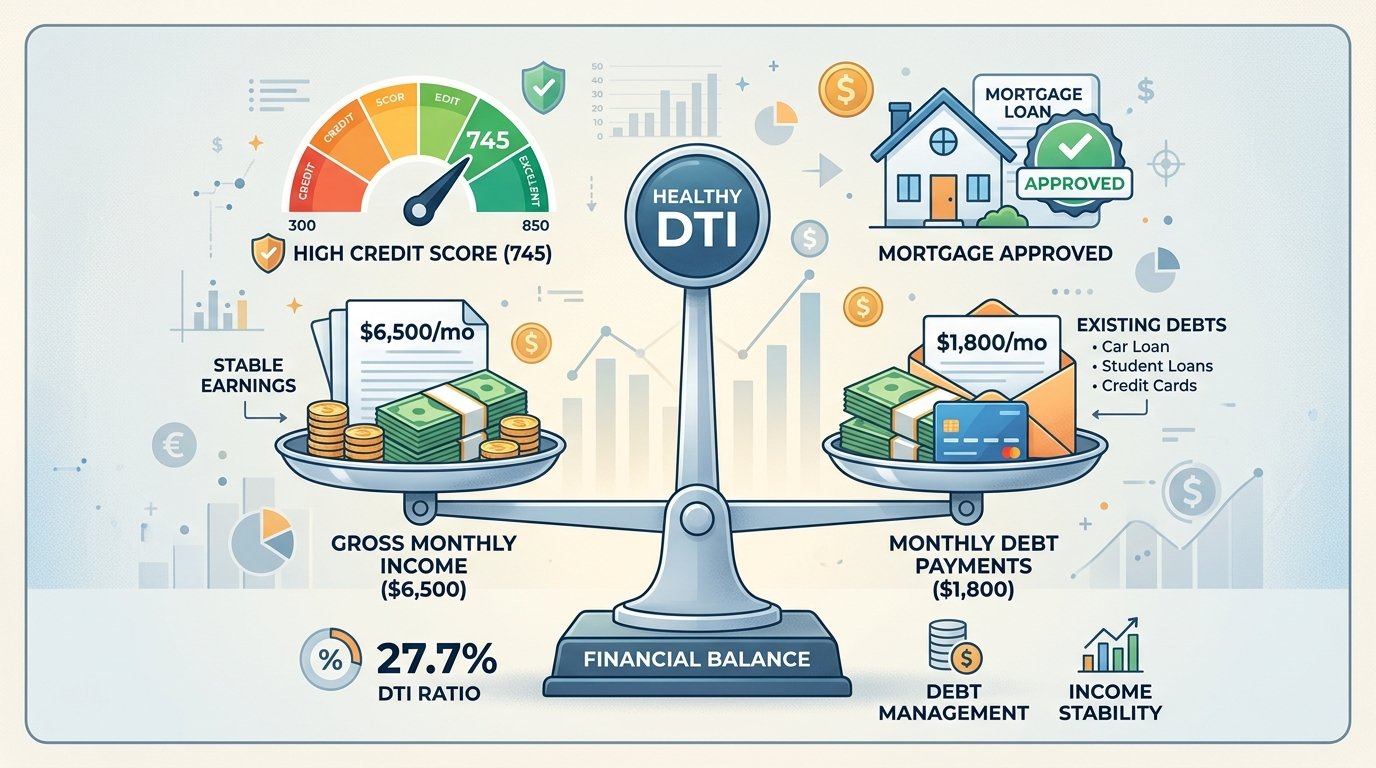
Your Debt-to-Income (DTI) ratio is the percentage of your gross monthly income that goes toward paying recurring monthly debt obligations. Using a Debt-to-Income Ratio Calculator tells mortgage lenders and banks how comfortably you can manage new monthly loan payments alongside existing debt commitments.
Why Lenders Measure Your DTI Ratio
When you apply for a home loan, car loan, or personal credit line, financial institutions look at two main factors: your credit score and your DTI percentage. While your credit score shows your past repayment track record, your DTI ratio measures your current cash flow bandwidth.
A borrower earning ₹150,000 per month who pays ₹100,000 toward existing loans has less financial flexibility than a borrower earning ₹80,000 per month with zero debt obligations. Calculating DTI reveals your true borrowing capacity and financial health before you submit a loan application.
The DTI Formula Explained
Calculating your DTI percentage requires comparing your total monthly debt payments against your gross monthly income before taxes and deductions. The mathematical DTI formula is written as:
Where the components include:
- Total Monthly Debt Payments: Recurring loan obligations like home loan EMIs, car loan payments, minimum credit card dues, and personal loans.
- Gross Monthly Income: Total pre-tax income earned from salary, business profits, rental income, or investments.
What Expenses Count in DTI Calculations?
It is important to know which monthly expenses to include when you calculate DTI:
| Included in DTI (Debt Obligations) | Excluded from DTI (Living Expenses) |
|---|---|
| Home loan & mortgage EMIs | Groceries & monthly household food |
| Auto loan & personal loan payments | Electricity, water, gas & utility bills |
| Minimum monthly credit card payments | Mobile, internet & entertainment subscriptions |
| Student loans & educational debt | Health & auto insurance premiums |
Front-End vs. Back-End DTI Ratios Explained
Mortgage underwriting guidelines break debt obligations down into two distinct metrics: Front-End DTI and Back-End DTI. Understanding the distinction helps you prepare a stronger mortgage application.
1. Front-End DTI (Housing Ratio)
Front-End DTI measures the percentage of your gross monthly income spent strictly on housing expenses. This includes prospective home loan principal, monthly interest, property taxes, homeowner's insurance, and homeowners association (HOA) fees. Lenders generally prefer a Front-End DTI of 28% or lower.
2. Back-End DTI (Total Obligation Ratio)
Back-End DTI measures all recurring monthly debt payments combined—including housing costs, auto loans, personal loans, student debt, and credit card minimums. This is the comprehensive number calculated by our DTI ratio calculator. Lenders benchmark Back-End DTI at 36% or lower for prime mortgage rates.
How DTI Influences Home Loan Amounts
Lenders calculate your maximum allowed monthly payment by multiplying your gross monthly income by the target DTI limit (e.g., 36%), then subtracting your existing monthly debts. The remaining amount represents your maximum affordable monthly mortgage payment.
If you earn ₹150,000 per month and have ₹24,000 in existing car and personal loan EMIs, your maximum allowable total debt at a 36% DTI limit is ₹54,000. Subtracting ₹24,000 leaves a maximum affordable housing EMI of ₹30,000 per month.
Step-by-Step DTI Calculation Example
Let's walk through a realistic household budgeting example using our monthly debt calculator steps.
Assume your household earns a gross monthly income of ₹120,000. Your monthly recurring debt payments consist of:
- Car Loan EMI: ₹18,000
- Personal Loan EMI: ₹12,000
- Credit Card Minimum Payments: ₹6,000
- Total Monthly Debt: ₹36,000
Applying our debt income calculation formula:
( ext{DTI Ratio} = left( rac{36,000}{120,000} ight) imes 100 = 30%)
Your current DTI ratio is 30%. This indicates strong creditworthiness and healthy borrowing capacity for an upcoming mortgage application.
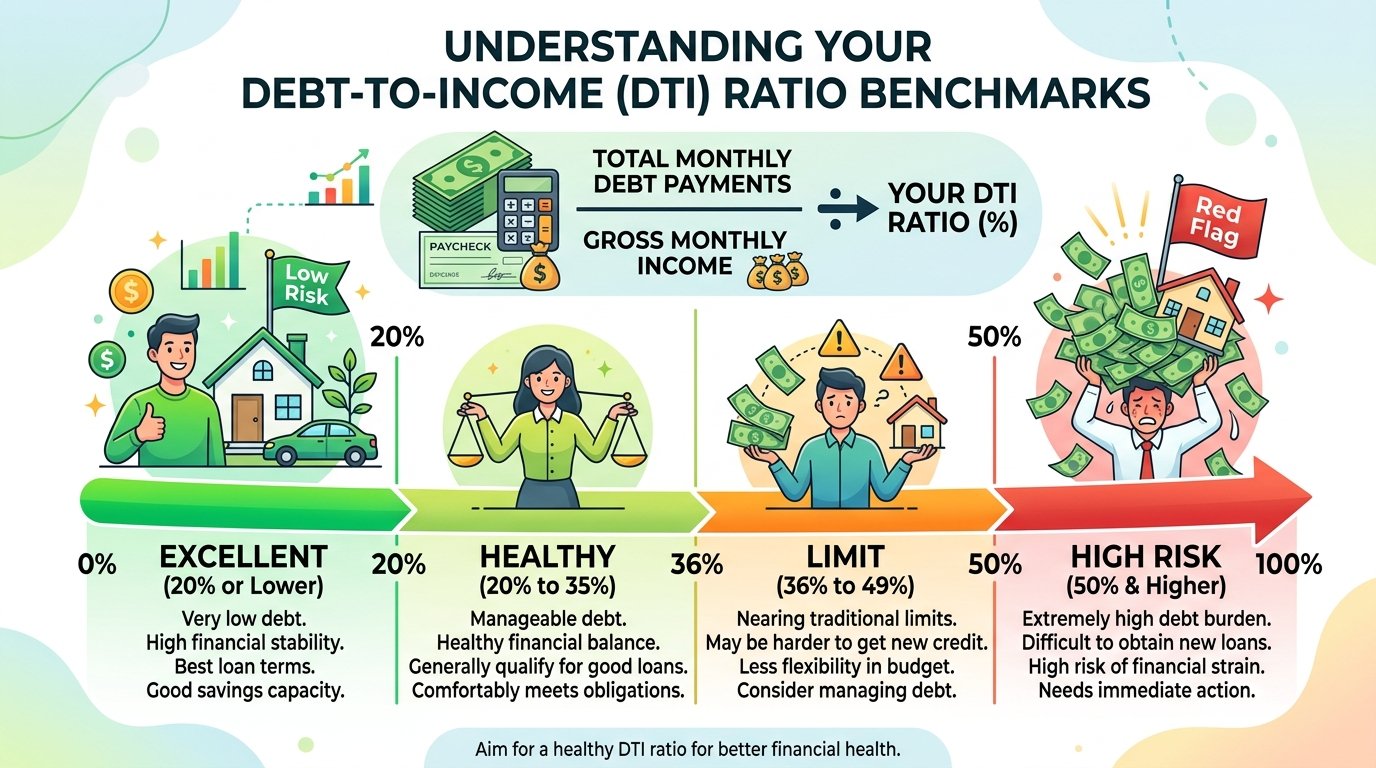
DTI Benchmarks: How Lenders View Your Score
Mortgage lenders categorize DTI percentages into distinct risk tiers:
- Under 20% (Excellent): You have significant disposable income and minimal debt burden. Loan approvals are quick with favorable interest rates.
- 20% to 35% (Healthy): Your debt load is manageable. Most banks view this range as low risk for home loans or auto financing.
- 36% to 49% (Caution Zone): You are spending nearly half your gross income on debt. Additional loan approvals may require a higher credit score or co-signer.
- 50% or Higher (High Risk): Over half your earnings go toward debt. Most traditional lenders reject new credit applications at this level until existing debts are reduced.
Strategies to Lower Your DTI Ratio
If your mortgage DTI calculator check shows a ratio above 36%, apply these practical debt management steps before applying for new credit:
1. Pay Off Small Credit Balance Lines
Paying off small credit card balances eliminates recurring minimum monthly payments from your debt total, dropping your numerator immediately.
2. Avoid Taking On New Debt Before Applying
Refrain from purchasing a new vehicle or taking out personal loans in the 6 to 12 months leading up to a home loan application.
3. Increase Your Gross Income Documentation
Include verifiable secondary income sources like freelance earnings, annual bonuses, or rental income to increase your denominator.
Explore Related Financial Planning Calculators
Check out our free, privacy-first online loan and mortgage tools:
- Loan EMI Calculator
- EMI Formula & Calculation Guide
- Mortgage Payment Calculator
- How to Calculate Mortgage Payments
- Percentage Calculator
- All Financial Tools
📚 External Scientific References & Authoritative Sources
- Investopedia Financial Library — Compounding Growth, Ratio Calculations & Financial Formulas.
- U.S. Securities and Exchange Commission (SEC) — Investor Education & Compound Interest Calculations.
- Reserve Bank of India (RBI) — Banking Regulations, Amortization Standards & Lending Guidelines.
Frequently Asked Questions
A DTI ratio under 36% is considered healthy by most mortgage lenders and banks. Ratios between 20% and 35% demonstrate strong borrowing capacity and creditworthiness.
DTI includes recurring monthly debt obligations such as mortgage payments, home loans, car EMIs, personal loan repayments, minimum credit card payments, and student loans. Utilities and groceries are excluded.
Credit score measures your past repayment reliability and credit history. DTI measures your current monthly debt load against your gross monthly income, indicating your ability to take on new loans.
While 36% is the preferred benchmark, some mortgage programs accept DTIs up to 43% or 50% if the applicant has compensating factors like a high credit score or substantial cash reserves.
Pay down high-interest personal loans, pay off small credit card balances to eliminate monthly minimums, or increase your gross monthly income through side earnings or salary increases.
Key Takeaways
Keeping your DTI ratio under 36% protects your financial flexibility and strengthens your loan approval chances. Calculate your monthly debt ratio regularly to maintain control over your household finances.